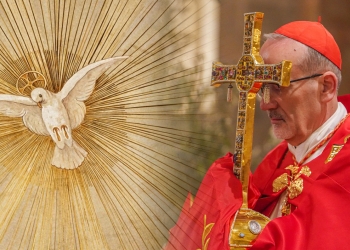
"Go, listen to everyone, dialogue with everyone, and pray for everyone.” With these words, Pope Leo XIV entrusted Archbishop Giorgio Lingua with his new mission as the representative of the Holy See in the Holy Land, a land that continues to endure the wounds of war, uncertainty, and tension.
On Thursday, May 28, Archbishop Giorgio Lingua made his solemn entrance into Jerusalem as Apostolic Delegate in Jerusalem and Palestine and Apostolic Nuncio in Israel, succeeding Archbishop Adolfo Tito Yllana. According to tradition, the solemn entrance into the Holy Sepulchre marks the official welcome of the newly appointed Apostolic Delegate to the Holy City.
At Jaffa Gate, one of the principal entrances to Jerusalem’s Old City and the historic gateway of pilgrims, the sound of the Arab Catholic Scout filled the streets with festive melodies as Heads of Churches, diplomats, religious men and women, and faithful gathered to welcome the Pope’s representative.
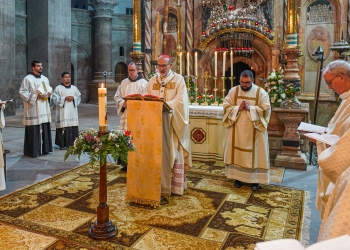
From there, the procession made its way to the Basilica of the Holy Sepulchre, where Archbishop Lingua was received by Fr. Francesco Ielpo, Custos of the Holy Land, together with representatives of the Greek Orthodox and Armenian Churches.

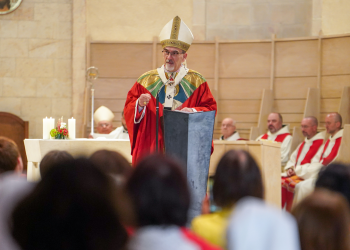
“The local Church, in all its diverse expressions, rites, and traditions, wishes to welcome you with an open and sincere heart,” said H.B. Cardinal Pierbattista Pizzaballa, Latin Patriarch of Jerusalem, in his welcoming address. He described the mission entrusted to the Apostolic Delegate as “a sign of the Holy Father’s fatherly care,” “a promoter of ecclesial communion,” and “a discreet yet steadfast voice for peace.”
“In this city — loved and contested, marked by a unique vocation to peace, demanding yet never impossible — your mission takes on profound meaning,” Cardinal Pizzaballa continued, highlighting Jerusalem’s vocation to remain a place of encounter, dialogue, and prayer among diversity of people and religion. Addressing Archbishop Lingua directly, he assured him of the support, prayers, and collaboration of the local Church: “Here, where the Christian presence has endured trials and challenges without losing faith, we assure you of our collaboration, our prayers, and our support.” Entrusting the new mission of the Apostolic Delegate to the Risen Lord, the Patriarch prayed that he may be sustained with wisdom and discernment, becoming “an instrument of peace, consolation, and living hope for all the communities of this land.”
Fr. Marcello Gallardo, General Secretary of AOCTS, then read the official letter of appointment from the Holy See.
Standing before the empty tomb of the Risen Christ, Archbishop Lingua delivered his first public address, structuring his reflection around the three words entrusted to him by Pope Leo XIV: listening, dialogue, and prayer.

“And here I am,” the Archbishop said, “completely unarmed. I bring with me only the heart and mind of the Successor of Peter, with his desire for peace and unity.”
Reflecting on the silence of the empty tomb, Archbishop Lingua spoke of the need to listen both to the cry of suffering and to the cry of hope rising from this land. He expressed his commitment to listening to Heads of Churches, political and diplomatic authorities, the faithful of the local communities, pilgrims, and all those who sincerely seek God.
Speaking about dialogue, he described it not merely as a diplomatic necessity, but as “an act of faith,” especially in a land marked by wounds and divisions. “There is no obstacle that cannot be overcome; no separation that cannot reach reconciliation, no war that cannot be transformed into peace,” he said.
Archbishop Lingua also reflected on the Christian vocation to unity and on the delicate responsibility of safeguarding the Status Quo that governs the Holy Places. He stressed that the longed-for unity among Christians is not a utopian dream, but a real possibility rooted in faith in the Risen Christ. “Every time Christians of different traditions speak to one another with charity, they profess their faith,” he said, affirming that if the stone of the tomb has been rolled away, then “all the stones that divide us” can also be removed through respectful dialogue, mutual charity, and patient collaboration in the shared care of the Holy Places
The final part of his reflection was dedicated to prayer, particularly for victims of violence, oppression, and war. Remembering all those who mourn and all those who continue to suffer throughout the region, he affirmed that the Holy Father had asked him to think first of them.

The solemn entrance of Archbishop Giorgio Lingua into Jerusalem thus marked not only the beginning of a new diplomatic mission, but also the renewal of the Holy See’s closeness to the peoples and Churches of the Holy Land. Entrusted with a ministry rooted in listening, dialogue, and prayer, the new Apostolic Delegate begins his service at a time of profound suffering and uncertainty, carrying with him the appeal of Pope Leo XIV to be a presence of communion, peace, and hope in the very land of Christ’s death and Resurrection.