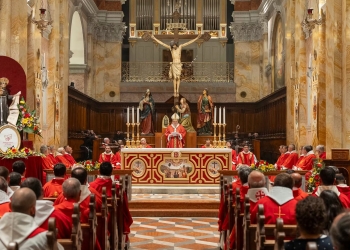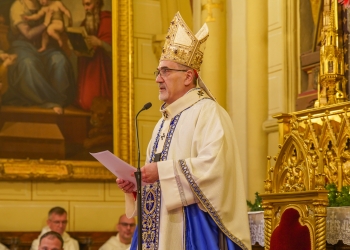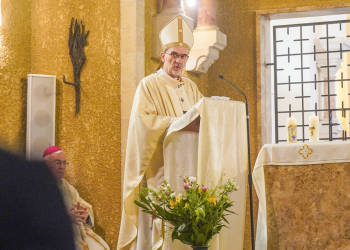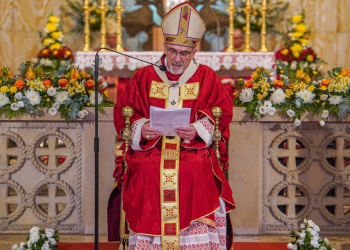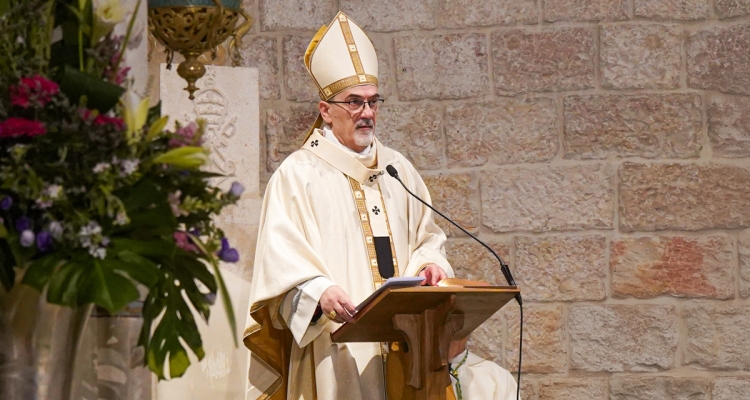
Homily of the Farewell Mass for Arhbishop Adolfo Tito Yllana
Jerusalem, March 12, 2026
Jer 7:23-28; Lk 11:14-23
The time of fulfillment and thanksgiving
Excellencies, brothers and sisters in the Lord, may the Lord give you peace!
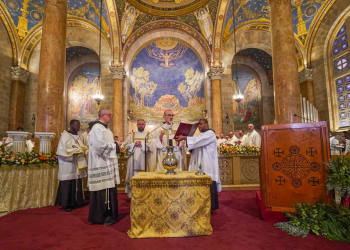
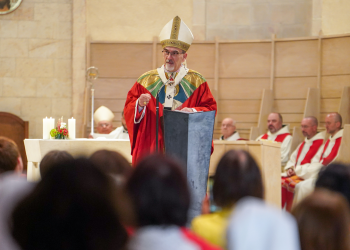
We are gathered at this Eucharist to experience an intense and, in some ways, “bipolar” time of grace: a time of thanksgiving and farewell. This moment marks the end of an important chapter in Archbishop Adolfo Tito Yllana’s service as Apostolic Nuncio to Israel and Apostolic Delegate to Jerusalem and Palestine.
Today’s readings, which we did not choose but which the liturgy offers us on this weekday, are providentially relevant for understanding this moment. They speak to us of listening, spiritual struggle, and the need to choose sides. They guide us in understanding the ministry of the Nuncio: a role that involves listening to the Word and supporting God’s people on behalf of the Holy Father, even in a land as complex and captivating as the Holy Land.
1. The difficulty of listening and the consolation of faithfulness (Jer 7:23-28)
The prophet Jeremiah introduces us to a dramatic dialogue between God and his people. God says, “Listen to my voice, and I will be your God and you will be my people.” The command is clear: walk on the path God shows, looking forward with confidence. Yet the people do not listen; they “proceed according to the stubbornness of their evil hearts,” and, as the text says so strikingly, (literally)“instead of going forward, they go backward” (Jer. 7:24). They look back, regretting a past that was also one of slavery, because the wilderness of freedom is frightening.
Bishop Yllana, for 42 years in the diplomatic service of the Holy See, represented a man, the Pope, who is the living symbol of that “walking forward.” The Nuncio is not just a diplomat; he is the one who, in a foreign land, must keep alive the voice of the Holy Father, of the Church, even when that voice is uncomfortable, even when – like Jeremiah – one has the impression that “they will not listen” (Jer. 7:27).
In these years in the Holy Land, Your Excellency, you have experienced how difficult the prophecy of listening is. In a land torn by conflicts, wounds, and misunderstandings, where parties often “harden their necks” and “truth seems to have disappeared” (cf. Jer. 7:28), your task has been to patiently weave relationships, keep dialogue open, and ensure that the voice of the Gospel and of reason is not drowned out by the noise of weapons or the stubbornness of prejudice.
Today, as your service comes to an end, this reading offers us consolation: the prophet is not judged by success, but by faithfulness. You announced, you called, you testified. Now the Lord says to his servant: “I have seen your work, now pronounce a word of farewell upon them, entrusting them to my mercy.” God will do the rest.
2. The “finger of God” in a divided land (Lk 11:14-23)
Luke’s Gospel brings us to the heart of Jesus’ mission and, by extension, to the heart of a Nuncio’s ministry in the Holy Land.
Jesus casts out a demon that renders a man mute. The Pharisees, blinded, cannot deny the miracle but attribute its origin to Satan. Jesus exposes this perverse logic: “Every kingdom divided against itself is laid waste, and a divided household falls” (Luke 11:17).
Here is the point. Let us look at the land where we celebrated this farewell Mass. It is a land that appears tragically “divided against itself.” The Israeli-Palestinian conflict is the most obvious wound. But there are also internal divisions, suspicions, and physical and spiritual walls. Yet, in this Gospel, Jesus claims his actions not as works of division, but as signs of the “finger of God.” “But if it is by the finger of God that I cast out the demons, then the kingdom of God has come upon you.” (Luke 11:20).
Over the years, Your Excellency, you have witnessed and promoted many signs of the “finger of God.” Despite diplomatic sometimes complicated relations between the Holy See and Israel, and despite difficult political moments, the Church in the Holy Land continues to live. Catholic schools, hospitals, parishes, and interfaith dialogues are proof that the Kingdom of God is at work. They are proof that there is a “stronger one” (Luke 11:22) who has already overcome the world and continues to “divide the spoils,” that is, to scatter the gifts of salvation.
The Nuncio is the ‘servant’ on the front lines, dedicated to protecting and encouraging these efforts. He knows that there is no such thing as neutrality here: “Whoever is not with me is against me, and whoever does not gather with me scatters” (Luke 11:23). Being Church in the Holy Land means “gathering,” not dispersing. It means being instruments of unity where the world sows division. For this, the local Church’s thanks to those who have carried out this delicate task is both due and necessary.
3. Farewell and Hope: A Look Beyond One’s Own Horizon
Msgr. Yllana, you are leaving this office today. You do so “at the end of the age limit,” as the law of the Church requires. But for a believer, and for a bishop, this is not simply a retirement. It is an Passover, a passage.
The first reading spoke of a people “looking backward.” Our gaze, instead, must be turned forward. Your service ends here, but your mission in the Church continues. The Seminary, the Academy, the Nunciatures in Papua New Guinea, Pakistan, Congo, Australia: all this was a great “gathering” with Christ.
Today, as you descend from this mountain, you carry with you the experience of having touched the “finger of God” in one of the most beautiful and complex lands in the world.
We remain here. On behalf of this community, the Church in Israel and Palestine, we want to express our heartfelt gratitude. Thank you for listening, for speaking up, for keeping silent when necessary.
Thank you for representing that “stronger one” who is Christ, defending the weak, encouraging the little ones, standing by the shepherds and the flock.
Thank you for never growing tired of “gathering,” even when it was easier to let things scatter.
And for us, who remain at this “crossroads of peace,” we ask for the strength not to look back in fear, but to continue walking, with hope, toward the fullness of the Kingdom, certain that the “finger of God” has not abandoned this land.
Let us now entrust Bishop Adolpho Tito Yllana to the Virgin Mary, “Queen of Palestine” and “Daughter of Zion,” she who more than any other has “heard the voice of the Lord and kept it.” May Mary accompany him on his journey.
Have a good journey, Your Excellency, and may the Lord grant you the joy of seeing Him face to face, He who is the Truth that never passes away.
Amen.