Homily for the Solemnity of the Annunciation of the Lord
Nazareth, March 25, 2026
Isaiah 7:10-14; Psalm 39; Hebrews 10:4-10; Luke 1:26-38
Beloved brothers and sisters,
may the Lord give you peace!
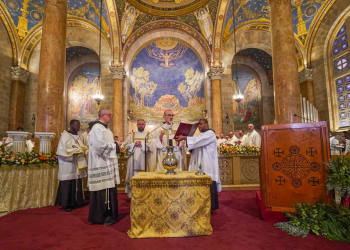
It is always a special moment when we gather here in this place, just steps away from that house – the womb where the infinite became finite, where the eternal Word learned to speak and grew “in wisdom and age and grace before God and men” (Luke 2:52).
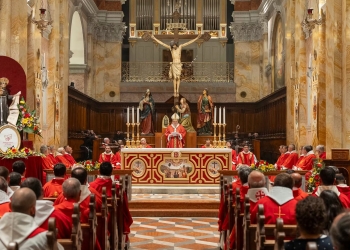
Today, our gathering is marked by a special silence. The streets of Nazareth are quieter, the echo of pilgrims’ footsteps nearly a memory, and the weight of these months of war, mourning, and division presses heavily on our hearts. Once again, we find ourselves in a state of emergency that forbids large gatherings or festive celebrations.
Yet, it is precisely in this silence, heavy with grief, that the Word of God today bursts forth with unprecedented power. Today, more than ever, we need to learn from the Virgin of Nazareth the hidden, yet decisive, art of reading history with God’s eyes.
The first reading presents King Ahaz, paralyzed by fear. His kingdom trembles under enemy threats. God, in His infinite patience, tells him, “Ask for a sign, either from the depths of the underworld or from above the heavens” (Isaiah 7:11) – any sign, to reach that closed heart. But Ahaz refuses, hiding behind false piety: “I do not want to tempt the Lord” (Isaiah 7:12). In reality, his refusal is the response of one who has already decided not to trust. He would rather cling to fragile political alliances and human strategies than open himself to God’s unpredictability.
But God does not give up. The sign comes anyway, gratuitous and scandalous: “Behold, the virgin shall conceive and bear a son, whom she shall call Emmanuel, God-with-us” (Isaiah 7:14). Today, that sign is no longer a distant prophetic word. That sign has a face, a name, a story. That sign is Mary, and that son is Jesus, the Emmanuel, God-with-us.
In a context far harsher than that of Ahaz – Roman oppression, poverty, a remote village – God does not send an armored army or a powerful king. He sends an angel to a girl. His strategy is always the same: weakness, humility, concealment. For it is only in this way that human freedom can meet Him without being crushed.
Luke’s Gospel describes the atmosphere of that encounter. The angel Gabriel enters Mary’s house, and his word shakes heaven and earth: “You will conceive a son, you will give birth to him, and you will call his name Jesus. He will be great and called the Son of the Most High” (Luke 1:31-32).
In light of this announcement, Mary is not the wax statue we sometimes imagine. Luke carefully describes her deep humanity: “She was greatly troubled and wondered what the meaning of such a greeting was” (Luke 1:29). She experiences the turmoil of someone called to take a leap of faith, yet moves forward with confidence. Then comes the question that is the keystone of the entire salvation story: “How will this take place?” (Luke 1:34).
Mary does not say, “I do not believe it.” She does not say, “It is impossible.” She asks, “How?” It is the question of reason seeking to understand, of realism not lost in dreams. Mary knows well that “she knows no man” (Luke 1:34). The angel’s answer is not a political project or a worldly reassurance. It is the announcement of a presence, a power from above: “The Holy Spirit will come upon you” (Luke 1:35). The final argument, the one that dispels any remaining shadow of fear, echoes the promise made to Abraham: “Nothing is impossible to God” (Luke 1:37).
Let us pause for a moment on this “nothing is impossible to God.” Here, in this basilica, it resounds as a captivating word. But spoken in our homes, in shelters, in hospitals where we mourn our dead, it can seem far removed from our experience. How can we repeat that “nothing is impossible to God” when missiles tear through the silence of the night, when all around us there is talk of death, when our Christian communities in the Holy Land are tempted by discouragement and emigration? How can we speak of the “fullness of grace” when life is full of toil?
The answer, the only possible answer, is given to us by Mary. Her joy is not the carefree cheerfulness of those who ignore pain. Mary’s joy is the deep, rooted joy of those who, even in the thickest darkness, choose to trust God. Her “yes” is spoken not in a flower garden, but in the heart of a world as torn as ours.
She knew what awaited her: a “yes” that would lead her into a misunderstood pregnancy, the risk of stoning, Joseph’s bewilderment, a birth in a stable, a hasty escape to Egypt to save the Child from another bloodthirsty king, Herod. Mary said “yes” not to earthly success, but to a project of love that passed through pain, exile, and, one day, Calvary. Her “yes” is already the entire way of the cross, but also all the light of the resurrection.
Today, here in the Holy Land, we are called to live this same mystery. The situation we face – marked by the open wounds of war, divisions tearing at the social fabric, and the uncertainty of tomorrow – is our “Nazareth.” It is here, in this bare reality full of turmoil, that God asks us to generate Christ. Our community, the parish of Nazareth, and our entire Church in the Holy Land, are called to be like Mary: a womb that welcomes life despite everything, a heart that does not close in fear, and that generates life.
The temptation is always that of Ahaz: to trust solely in our human strategies or to think there is no more hope, that nothing can be done to change this world. The temptation is to remain in worldly logic, to respond to hatred with hatred, to dehumanize those before us. But the school of Nazareth teaches us another way: the way of listening, of silence, of home life. It is the school of the Gospel (cf. Paul VI, Homily at Nazareth).
“Behold, I come,” says Christ as He enters the world. His “coming” is a “listening” to the Father. And Mary, by listening, makes room for the Word of God. Listening means, in our troubled families, finding time to hear the fears of our children and the weariness of our elders. It means, as a Church, being able to read the signs of the times – even the most dramatic ones – and see the call to a deeper conversion. It also means having the courage not to close our hearts in distrust and to continue to believe in the possibility of encounter with all in a land devastated by so much violence and division.
Dearly beloved,
Reality is not made up only of evil. In this reality, amidst the rubble, there is still the presence of God. There are mothers who hope, fathers who work, children who play, and elderly people who pray. There are Christians who choose to stay, to love, to forgive. That is where we meet God.
That is our mission: to be those who, in the darkness of war, can see the shoots of God’s presence. To be peacemakers not with abstract declarations, but with the daily concreteness of those who, like Mary, accept to carry the world in their wombs – with all its contradictions, pains, and beauties – and to suffer it, to transform it from within by the power of love alone.
Today, though few in number, on behalf of our whole Church and Christians all over the world, we also want to renew our “yes” to Christ, our decision to be with Him and to follow in His steps.
Today we entrust ourselves to the Virgin of Nazareth, to the heart of a Mother, and together with her and through her intercession, we entrust our Church in the Holy Land:
You who have known bewilderment and trembling, obtain for us the courage of “yes.” Help us not to flee from this reality, but to live it to the full, certain that for God nothing is impossible. Help us to be a Church that listens, a community that welcomes, families that do not close themselves off. Grant that, like you, we may bring Jesus – the Emmanuel, God-with-us – into the midst of this frightened world. May our lives, here in Nazareth and throughout the Holy Land, become that sign of hope, that little flower blooming among the rubble, to tell everyone that Love is stronger than death and that the Word made flesh continues to dwell among us. Amen.
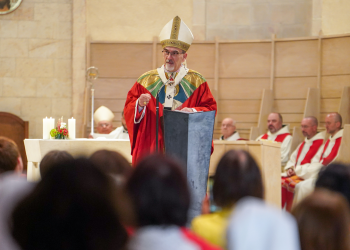
+Pierbattista Pizzaballa
Latin Patriarch of Jerusalem