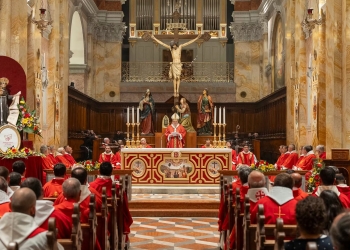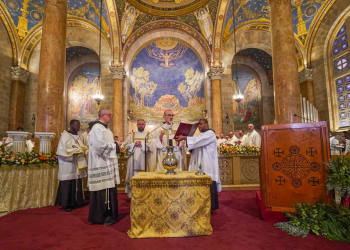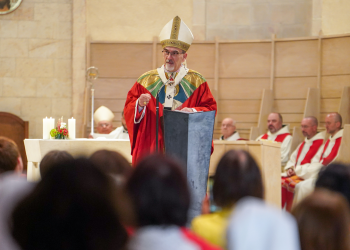
Brothers and sisters, all gathered here this evening in Jerusalem, precisely where everything began.
We are here: we belong to different rites; we are here as families, as movements, as religious sisters and brothers. We are here with our languages and our personal stories. Above all, we are here to listen.
We have listened together to the Word of God, and we will pray in different languages: French, English, Spanish, Hebrew, Arabic, Swahili, Tagalog, Malayalam, Portuguese, Chinese, Polish, and Amharic. It already feels like Pentecost: each of us hears about the great works of God in our own language. This is not a special effect. It is the reality of our Church in Jerusalem: a mosaic of languages, rites, cultures, and diverse sensibilities that nevertheless seek to be one body.
The first reading, from the Book of Genesis – that magnificent page on the creation of light – reminded us that God loves to separate in order to bring forth life: He separates light from darkness, the waters above from the waters below, day from night. Then, in the creation of man and woman, He tells us that He made us in His image, as relationship. We are not alone. We exist because we are in relationship.
But there is another separation in the second reading: Babel. There, too, God confuses and scatters humanity – not as a punishment, as we sometimes think, but to save us. At Babel, people wanted to make a name for themselves, to build a tower that would reach heaven, presuming to become like God. They wanted to unify all languages into one: “The whole earth had one language and the same words” (Gen 11:1). Then the Lord scatters them again and brings humanity back to the original intention, which is the fruit of the freedom for which He created us: linguistic and cultural diversity. The dispersion of Babel is an act of mercy: God halts our hubris, our arrogance of self-sufficiency, our desire to reduce everything to a single way of thinking. Since then, however, Babel has also left a wound in human relationships: the inability to communicate. We no longer understand one another.
But at Pentecost, something radically new happens. The Spirit enables each person to hear and understand in their own language. The Spirit does not impose uniformity; He creates unity. There is a subtle yet decisive difference. Uniformity is a prison; unity is a symphony. At Babel, the proliferation of languages leads to division and a breakdown in communication. At Pentecost, that very diversity of languages becomes the place where the love of God is understood by all.
That is why we are here in Jerusalem. We are the city of divided languages. We are the city of many physical and interior separations. We are the city where mistrust is often the first language we learn. Yet, we are also the city of the Upper Room. We are the city where the Spirit descended. We are called to live not the Babel of war, but the Pentecost of encounter.
Brothers and sisters, let us pray for the Church, for the unity of Christians, for peace, for young people, for migrants, for the poor. Let us pray especially for our diocese: a small, poor, but living diocese. We are in a Salesian house, which carries in its heart the charism of youth; let us pray for our young people. How many of them here in Jerusalem, in the Holy Land, have lost hope. How many think that the only language is that of violence or resigned silence. Let us ask the Spirit to urge them to build, to proclaim with their lives that here in our Holy Land another story is possible.
Let us pray for migrants and refugees. Jerusalem is their city, because here God promised to gather the scattered. Every time we welcome a stranger, every time we listen to a different language without fear, we are living Pentecost.
There is a wonderful verse in the passage from Joel that we heard: “Even upon the servants and the handmaids I will pour out my Spirit” (Joel 2:28). The Spirit does not look at titles, functions, or roles. He does not care whether you are a priest or a layperson, whether you belong to the Neocatechumenal Way or the Focolare Movement, whether you are Franciscan or Carmelite. The Spirit is like the wind: he blows where he wills. You do not know where he comes from or where he goes. The only thing you can do is leave the door of your heart open.
Perhaps this evening some of us feel tired – tired of divisions, even within the Church; tired of misunderstandings, gossip, and jealousy. Perhaps we feel the weight of ministry, consecrated life, or family life. The Spirit comes precisely upon this weariness. He does not come only upon enthusiastic souls; he also comes upon weak flesh, as Joel says – upon all flesh, upon our flesh, with our failures and our sorrows.
So let us allow ourselves to be shaped. Let us not be afraid of fire. The fire of the Spirit does not destroy; it purifies. As we sang in the Sequence: “Wash what is unclean, water what is dry, heal what is wounded.” Yes, we need to be washed, watered, and healed.
At the end of this vigil, we will go out. And we will not go out alone. We will go out as the community of believers who, on the day of Pentecost, went forth from the Upper Room. They were no longer the same. They no longer spoke only Aramaic; they spoke all languages. And people said in amazement, “How is it that we hear them, each in our own native language?” (Acts 2:8).
May it be that tomorrow, when we meet one another in the old streets of Jerusalem, in our villages of Galilee, or in our parishes of Jerusalem, someone may look at us and say, “How is it that, in the midst of so much anger and fear, these people are still able to speak to one another, to seek one another out, to love one another?”
Then the Spirit will truly have descended.
Come, Holy Spirit. Come.
Amen.