Homily for the Feast of St Francis of Assisi
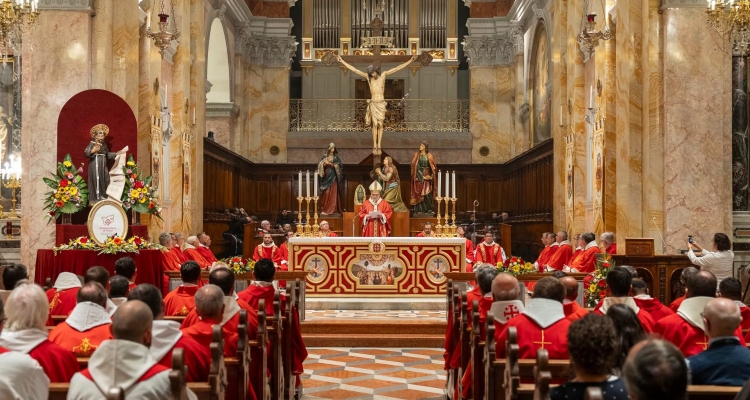
San Saviour Church – Jerusalem, 4 October 2026
Most Reverend Excellencies,
Most Reverend Father Custos,
Dear brothers and sisters,
may the Lord give you peace!
Celebrating Saint Francis in Jerusalem, on the 800th Anniversary of his Transitus, is a gift of grace for the entire Church in the Holy Land. In gratitude to the Franciscan family and for the service of the Custody, I would like to begin with an essential question: What form does the Gospel take today in our personal lives and in our communities?
The Gospel we have just heard begins with Jesus praying these words: “I give praise to you, Father” (Mt 11:25). These words were spoken at a difficult moment in His ministry, as he just encountered misunderstanding and rejection. Shortly before, he had rebuked the towns that did not accept His call to conversion. And yet He continues to recognize the Father’s work. He knows that the seed of the Kingdom finds a home in the little ones and that the Father remains faithful.
This trust safeguards His freedom. The rejection he faces wounds Him, but it does not prevent Him from loving and continuing the mission He has been entrusted with. This is an important word for us today, who are called to live our faith in a world where hardship, pain, and uncertainty can take up our entire horizon. Even the Church can become absorbed in her own concerns, to the point of measuring the prospects of the future solely by the difficulties of the present.
St. Francis invites us to broaden and renew our gaze. In the Testament, when he recounts his vocation, he continually acknowledges the Lord’s work and initiative: it was God who guided him, gave him brothers, and helped him understand how to live. At the origin of it all is a gift that was received. And when he seeks words to express the path he has been given, he speaks of living “according to the form of the Holy Gospel” (Testament, 14). He entrusts this way of life to the affirmation of the Church.
As a shepherd of this Church, I wish to begin from here. Renewal begins when the Gospel truly returns to guide our choices. The Church in the Holy Land—and first and foremost the Custody—safeguards a rich history of Holy Sites, educational and charitable institutions, and centuries-old traditions: an inheritance entrusted to us so that it may continue to communicate the life of Christ to the men and women of today.
But it is not enough simply to stop and contemplate what has been accomplished. We must always ask ourselves what truly helps people to encounter the Lord. The Word of God must be listened to and become a criterion for discernment; the sacraments must be accompanied by care for the faith; lay people, families, and young people need spiritual formation and pastors who are willing to listen. In light of this evangelical fruitfulness, we are called to examine how we use our energies and resources.
Jesus’ invitation, “Come to me” (Mt 11:28), is also addressed to us who serve the Church. Our work needs to be drawn continually from this relationship. A community that prays, listens to the Word, and allows itself to be reconciled by the Lord becomes more able to accompany others with greater freedom. It can also be challenged to change because it recognizes in Christ the source of its life, rather than in its own strength or in strategies that often prove short-sighted.
The witness of Francis then leads us to fraternity. He receives his brothers as a gift from God. This awareness concerns us all. Ecclesial communion is a responsibility that precedes our individual plans and calls us to give concrete expression to our belonging to a one body.
The Church in the Holy Land exists across different countries, languages, histories, and cultural sensibilities. At times, we celebrate the Eucharist only a few kilometers from one another and yet we find it difficult to encounter one another. Borders, restrictions on movement, and the weight of history make it more difficult for us to get to know one another. Precisely for this reason, communion cannot be taken for granted: it must be sought out and patiently nurtured.
The different charisms, too, are called to serve this communion. The Custody, parishes, the religious communities, the movements, and the many ecclesial works each bring a gift that bears fruit by entering into relationship with the others. Discernment concerning pastoral priorities must help us recognize together what the Church needs, coordinate our efforts, and support those who are most vulnerable. Collaboration lived in trust also makes our proclamation more credible.
I express the gratitude of the Church of Jerusalem to the Custody for its fidelity and service. May your international fraternity continue to be a witness of communion for this entire land.
Communion, in turn, opens us to mission. In his Testament, Francis recalls that the Lord led him among the lepers. Precisely by drawing near to those from whom he had previously kept his distance, and by showing them mercy, that he experienced the transformation of his own heart. For our Church, too, renewal passes through the neighbors we avoid, the poor and the suffering we fail to see, and the questions that challenge our habits. I think of the families struggling to remain in this land, the elderly who are often alone, the workers who are unable to bear the weight of daily life, and the young people who look to the future with uncertainty and wonder if there is still a place for them here.
Franciscan minority points us toward a way of being present: standing beside people with the freedom of one who does not need to assert oneself. For our Church, this means making Christ recognizable through a generous presence, open to all. Even our relationships with our Jewish and Muslim neighbors call for this freedom, one capable of safeguarding encounter without renouncing the clarity of faith.
Jesus shows us the way of this presence: “Learn from me, for I am meek and humble of heart” (Mt 11:29). Gospel meekness requires great inner strength. It commits us to seeking justice and speaking the truth, while remaining vigilant lest pain and indignation take hold of our hearts.
Let us bring in prayer the sufferings of all the families in our Holy Land marked by violence—those who mourn a loved one and those who fear the future. As the Church, we have a duty to stand close to those who suffer, to defend human dignity, and to give a voice to those who are deprived of it. This responsibility also calls us to exercise a demanding freedom with regard to affiliations and divisions that would seek to decide in advance which forms of suffering deserve to be heard.
Our public voice must spring from the Gospel and from closeness to people. It will be credible if we know how to support those in need, educate young people for to encounter others, and continue to build relationships even when everything pushes us to break them. This is how peace begins to take on a face.
For this reason, I feel the educational task to be an urgent one. Young people need to find meaning in their presence here, discern their vocation, and assume responsibility. Let us listen to their questions and make room for their gifts: the future is prepared by placing trust in those who have something to offer.
Here in Jerusalem, we safeguard the places of the Paschal Mystery. At Calvary, we learn how far the love of God reaches; at the empty Tomb, we receive the foundation of hope: the Father raised the Son, and death has been overcome. This faith sustains us when the fruits remain hidden and gives us patience in situations for which we do not yet see a way out.
I would therefore like this centenary to leave a tangible fruit in the journey of your community and in the Church as a whole. Let us ask ourselves, in prayer and shared discernment, what step the Lord is asking us to take in order to live the Gospel more faithfully and to serve this land better. From this question, concrete choices can emerge, to be carried forward together with perseverance. In this way, the memory of Francis will become a responsibility embraced in the present.
May Saint Francis intercede for the Custody, for the entire Church in the Holy Land, and for every inhabitant of this land. May he help us to welcome what the Lord still wishes to accomplish among us and to offer Him, with trust, our willingness to serve. Amen.