By Emiliano Eusepi
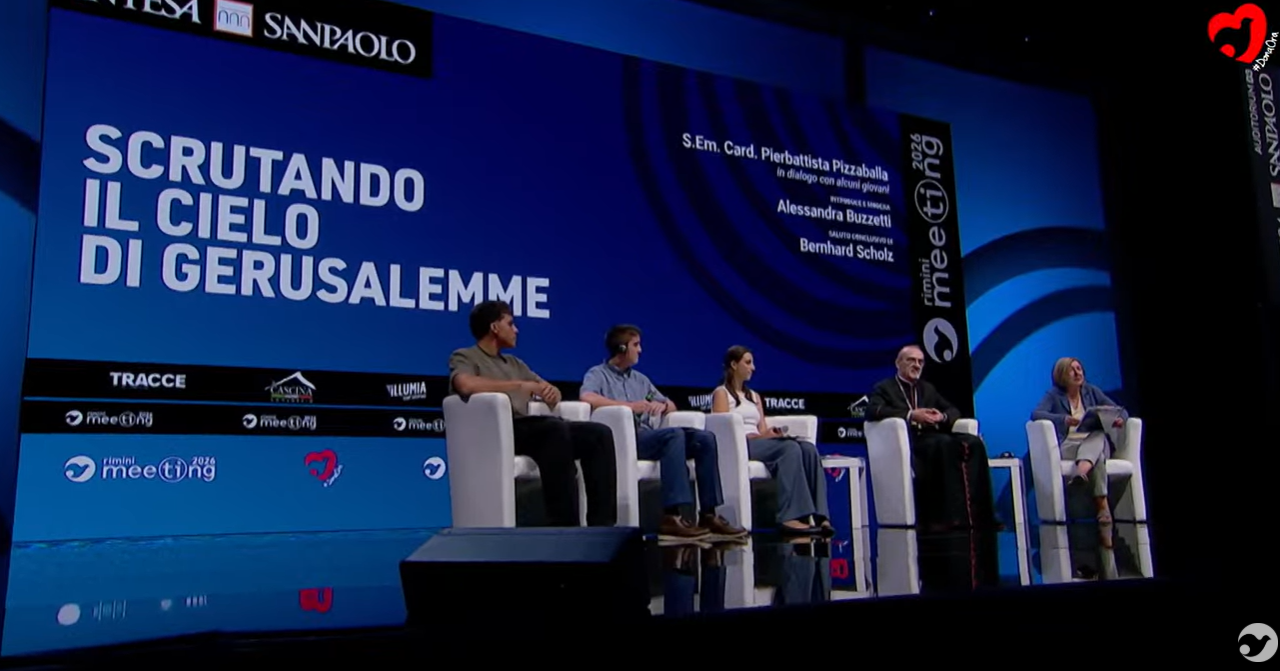
“What does it mean to gaze upon the sky of Jerusalem?
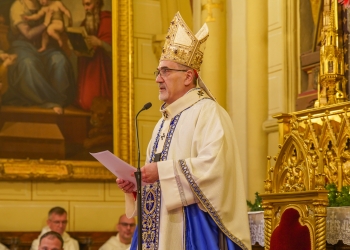
It means looking very deeply at reality – not just that of the conflict in the Holy Land, but the reality of global chaos that the whole world is experiencing.” With these words, the journalist Alessandra Buzzetti opened the session on the final day of the Meeting for Friendship amongst Peoples, held annually in Rimini. Faced with a ‘global disorder’ where all the rules seem to have been thrown out the window, the Patriarch answered questions from some young people, inspired by his pastoral letter, and offered those present a powerful testimony of hope. The dialogue with the young people also touched on more personal topics, such as when a young woman asked His Eminence about his pain as the shepherd of a Church that is suffering: ‘We have all been affected in different ways by so much pain,’ replied the Patriarch. ‘The pain of broken relationships for having said something that didn’t go down well, the pain of people who are no longer with us, of the violence you witness, of your sense of powerlessness.’ And the Patriarch did not hide his own suffering: ‘The experience of pain sometimes makes you feel inadequate, not up to the task. In my role, people sometimes call on you from all directions, seeking help, and you realise you cannot be everywhere at once. All of this gets to you, and you cannot always cope with those situations. It is only human; I am no superman.”
But precisely in the face of our inability to find solutions to all this suffering, our response must not be to rely solely on political solutions, or on violence, but on prayer and contemplation of the cross: ‘Prayer is important because it is the only place where you can surrender your powerlessness. Look at the cross: the cross is the place where Jesus fails as a human being, and yet for us it is the source of salvation. This helps you to put things into their proper perspective. When at times you can’t cope any longer or you fall, what matters is knowing that you have a place to return to, that it is never quite over, and that you can always, by looking to Him, start afresh.’ For the Patriarch, empathy and a tangible presence alongside people remain the fundamental remedy against isolation: ‘There is one thing we must never forget, especially in times of suffering: we are not left alone. Empathy, more than many words, lies in being there, in being present. And this applies to everyone, even to cardinals.’
Another topic addressed during the meeting was that of forgiveness and the refusal to view the other as an enemy. When asked how it is possible to love those who do evil and to forgive in such difficult circumstances, the Patriarch highlighted a fundamental distinction between the personal and the social spheres: ‘On a personal level, forgiveness knows no time. At any moment, you may be called upon – and you are called upon – to forgive. We have countless accounts of people who, when faced with their attackers at the moment of death, were able to forgive. These are necessary, beautiful, marvellous, fantastic testimonies’; however, at the community level, the perspective changes and requires a process of purifying memory and healing wounds, which is very difficult and takes a long time: ‘At the community level, at the social level, the dynamics are different; the timescales are not all the same. We must know how to wait and be patient; we must know how to prepare the community, first and foremost, to understand what has happened, to assess it properly, to heal and then also to forgive. We must not draw a naive distinction between these levels: people who are capable, on a personal level, of offering forgiveness are the building blocks of a journey that the community too must undertake—a journey that is, however, more arduous, more difficult and slower, but no less necessary.”
Finally, Patriarch Pizzaballa also pointed out that hope is not a naïve expectation of an immediate political solution, but rather a sign of an inner presence; and that courage is needed to create ‘openings’ in the walls of hatred through encounter with the other, recognising their face and history beyond any abstract category. He concluded by saying: ‘Passion is contagious: not through complicated speeches, but through enthusiasm, joy and friendship, which can inspire others. And besides, you cannot expect everyone to understand you: those who follow you are welcome, and the others are welcome too, and you pray for them. We must not do things for the sake of the outcome: what must drive us is not the result, but the desire.’