November 8, 2026
XXXII Sunday in Ordinary Time, Year A
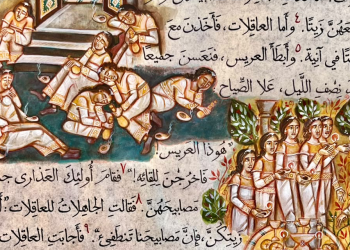
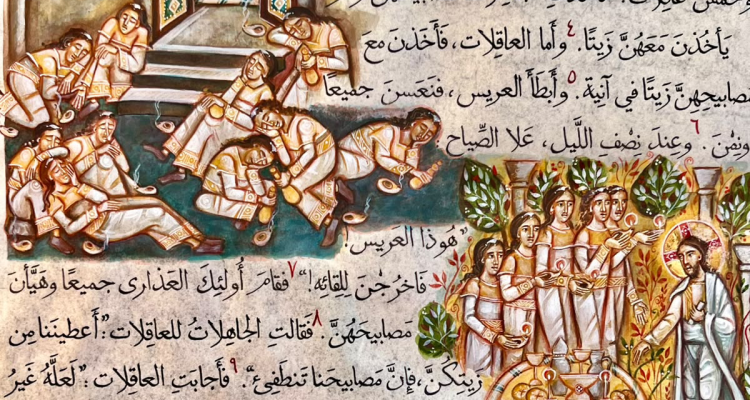
I want to focus on a word that recurs several times in the Parable of the Ten Virgins (Mt 25:1–13), which is offered to us today by the Liturgy. That word is: foolish.
Five of these young women are wise, while five are foolish (Mt 25:2, 4, 8). Outwardly, the foolish and the wise have a lot in common: all ten go out to meet the bridegroom (Mt 25:1), all have a lamp (Mt 25:1), all fall asleep (Mt 25:5), all are taken by surprise at the arrival of the bridegroom (Mt 25:6), and all wake up (Mt 25:7).
Then, the difference does not lie in the fact that some fell asleep and others did not.
The difference lies in what they did before falling asleep, because the wise ones stored up oil for themselves, while the foolish ones did not: thus, when the bridegroom arrived, they had enough oil (Mt 25:7) and were ready to meet him (Mt 25:10). While, the foolish ones had no oil left, hence, there meeting with the bridegroom does not happen (Mt 25:12).
But why are they foolish? What does it mean to be foolish? What is the difference between them and the wise?
One thing is important to clarify: the foolish ones are not bad people.
They do not do anything evil; they do not steal, nor harm anyone, nor abandon their bridegroom, nor do they stop waiting for Him.
Perhaps, to understand what this foolishness really means, it may be helpful to recall a characteristic of biblical foolishness. In the Book of Proverbs, the fool is not primarily someone who lacks intelligence. Rather, he is someone whose life is not shaped by the reality of God. This is why Psalm 14:1 says: “The fool says in his heart, ‘There is no God.”
This does not necessarily mean that he has developed a philosophical theory of atheism; rather, it is, at a deeper level, a way of living as if God’s existence does not really matter.
This is where it connects with our parable: the foolish virgins await the bridegroom, yet their lives are not wholly shaped or guided by this expectation. One can await the Lord's coming without truly allowing Him to transform one's life.
Proof of this can be found in the words of the foolish virgins, which they address to the wise ones when they all awaken at the bridegroom’s arrival: “Give us some of your oil, for our lamps are going out” (Mt 25:8). This, precisely, is foolishness: thinking that one can recover at the last minute what has been lost along the way. The foolish virgins have put off preparing for the encounter, and now they are looking for an immediate solution, but there is none to be found.
Foolishness is simply a relationship that is constantly put off until tomorrow, because the oil that prepares us for our encounter with the Lord is not a list of our good deeds, but the openness of our hearts to an ordinary, everyday relationship with Him. It is listening to His Word and participating in His gift
We could say that foolishness consists of thinking the time of waiting is not itself a time for relationship and following in His footsteps. Even if the Bridegroom takes longer to come, the relationship can and must remain alive.
But what happens during this time of waiting?
On the surface, nothing seems to happen: there is no feast, no encounter taking place, and the fulfilment has not yet happened.
Yet, precisely there the relationship happens. The Bridegroom’s delay is not simply time that keeps us from the encounter; it is time that prepares us for the encounter.
For in the meantime, we do not remain passive, waiting for an event to happen. Rather, we actively build for it and allow ourselves to be transformed by everything that happens to us in this time of waiting, allowing it to bring us closer to Him.
So it’s not a matter of being ready for a future appointment, but of ensuring that, when the Bridegroom comes, that encounter will be the fulfilment of a relationship that has already begun and is lived out day by day.
+Pierbattista
*Translated from Italian