August 23, 2026
XXI Sunday in Ordinary Time, Year A
The Gospel describes Jesus's and the disciples relationship as something that grows over time.
It all begins with Jesus, as He walks along the Sea of Galilee, He sees some men at work and calls them to follow Him (Mt 4:18ff.). His gaze reaches deep within; it is a gaze that knows them and sees them within God’s plan and the vocation to which they are called.
The disciples, too, gradually learn to see Jesus; they learn to know him. They see a Man, like themselves, but they also learn to see beyond that. They see that this Man, who shares life with them, bears within Him a unique mystery.
Today’s Gospel passage (Mt 16:13–20) marks an important stage in this journey of deepening knowledge of one another. We are in Caesarea of Philip, in the far north of the country, and Jesus questions his disciples about what they have seen and perceived in him so far. He does so with two questions. With the first, he asks what people think of him (“Who do people say theat the Son of Man is?”—Mt 16:13); with the second, he asks the disciples directly (“But who do you say that I am?”—Mt 16:15).
The two questions are important because the two answers differ.
The first response (“They replied, ‘Some say John the Baptist; others, Elijah; still others, Jeremiah or one of the prophets’” — Mt 16:14) reveals that people see only what is visible to the eye; they reduce Jesus to something they have already seen: a prophet, a man of God, a righteous man. The second response, Peter’s (“You are the Christ, the Son of the living God”—Mt 16:16), moves to a deeper level: Peter speaks words greater than himself—words that do not come from him alone, from his own abilities or intuitions, but from listening to what the Father has revealed to him.
At this point, one thing should be considered.
At the beginning of the Gospel (Mt 3:13–17), when Jesus goes down to the Jordan to be baptized by John, the Father makes His voice heard and proclaims that this man is His Son, the Beloved, in whom He is well pleased. In the middle of Matthew’s account (Mt 17:1–9), at the moment of Jesus’ transfiguration on the mountain, the Father again makes his voice heard, saying the same thing: (Mt 17:5).
“This is my Son, the Beloved.”
These are the most important and precious words a person can hear: They speak of belonging; they affirm that one’s life is precious; they give meaning to one’s entire existence. The Father recognizes the Son, giving him the certainty of being with Him in a unique and special relationship.
In some way, then, Peter, by grace, grasps something of this mystery, of this relationship between the Father and the Son. We could say that the words with which Peter confesses that Jesus is the Christ, the Son of God, are the very words of the Father — words that Peter hears within himself and through which he can come to know Jesus.
Peter sees Jesus as the Father sees him.
He doesn’t invent anything; he simply receives a revelation that the Father desires to give to every person.
For the Father’s greatest desire is to make the Son known, and the Son’s greatest desire is to make the Father known.
This is precisely what faith is. It is coming to know Jesus, as far as possible, as the Father himself knows him: as Son. And it is coming to recognize the Father, as far as possible, as the Son knows him: as Father.
This is what we are called to grow into, day after day, simply by listening deep within ourselves to what the Father reveals through the Spirit who speaks within us.
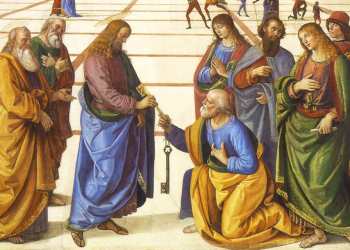
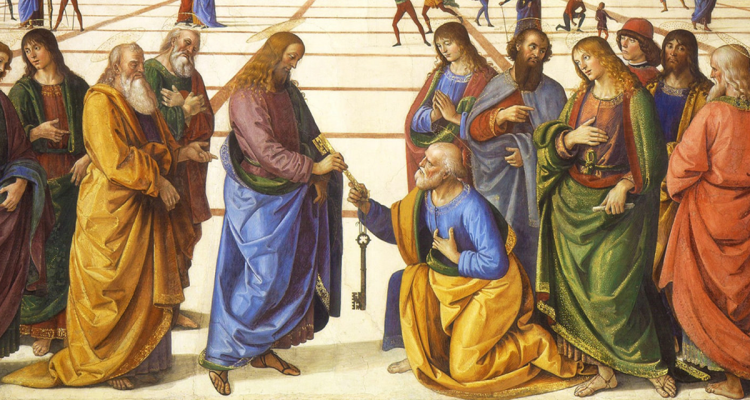
When this happens, we become more steadfast; we become a rock, like Peter (“You are Peter, and on this rock I will build my Church…”—Mt 16:18).
Being “rock” is not a psychological quality, nor a moral achievement, but the fruit of a relationship in which life flows, where we can know and be known. It is a rock that others can lean on and, in turn, build secure lives of their own, as trustworthy people because they have been recognized in their dignity as sons and daughters, loved by the Father as Jesus himself is loved.
+Pierbattista
*Translated from Italian