September 20, 2026
XXV Sunday in Ordinary Time, Year A
Last Sunday’s Gospel offered by the Liturgy (Mt 18:21–35) contained an underlying question, which can be expressed as follows: How worthy is the other person – the brother who sins against me – of my forgiveness?
Peter, in fact, had gone to Jesus precisely to raise this question. Jesus had already widened Peter’s understanding of what it means to forgive generously, freeing him from the temptation to calculate and measure.
Today’s passage also contains a question (Mt 20:1–16). It is no longer Peter who asks it, but it emerges from the parable that Jesus tells.
The parable is that of the workers of the last hour, and we could summarize the question this way: How worthy is the other person – my brother – of God’s love? Is he as worthy as I am?
It is an important question, because even today, as last Sunday, offers us a glimpse into God’s heart; showing us how He loves; revealing the dynamics of His Kingdom.
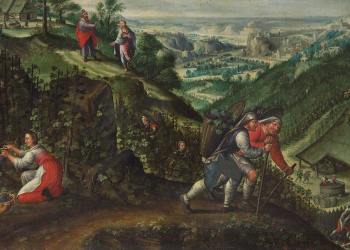
The parable is well known, yet it can scandalize us, because its logic is far off from the logic of our culture. A landowner goes out several times throughout the day to hire laborers for his vineyard. Only with the first group, whom he meets at dawn, does he agree on a wage, offering them one denarius a day (“After agreeing with them for the usual daily wage, he sent them into his vineyard”—Mt 20:2). All the other workers, he sent to the vineyard at various times of the day, some even at the very last hour, knowing only on that they will receive what is fair for their service (“You too go into my vineyard, and I will give you what is just.” — Mt 20:4).
So far, nothing out of the ordinary. The owner needs his vineyard to be tended to, and he keeps sending people there, regardless of how many hours they might work for.
As evening falls, something strange happens. The first is that the order of payment is reversed. And this is not by accident, but by the master’s explicit wish: “Summon the laborers and give them their pay, beginning with the last and ending with the first” (Mt 20:8).
Why this decision? The passage makes it clear that the decision is not random, but deliberate, so that those who came first might see the pay given to those who came last. The laborers hired at the first hour, in fact, clearly see the pay of those who began last; they know that they have been given the same wage the master had agreed upon with them, and having labored the whole day, they legitimately expect to receive more (Mt 20:10)
And here we find another strange thing. The laborers hired at the first hour, when they too receive only one denarius, do not complain about having received too little? Instead, they complain because the master treated the others the same way he treated them: “You have made them equal to us” (Mt 20:12). In other words, the master, in distributing his wealth, did not make any distinctions based on the workers’ merit. He applied a completely different logic.
The master’s logic is not a different version of human justice: it is not simply better or more generous; it is simply different—it is another way of perceiving value, time, and relationships—a logic that subverts human logic. Human logic evaluates, measures, and rewards according to the value of what each person has achieved, whilst respecting the proper proportions. God’s logic is different because He does not give things, but gives Himself—His free and total love, a love that precedes us and goes beyond us, and asks only to be received.
This treatment by the master—which shocks those who thought they had more rights—is the good news of the parable.
To tell us that salvation begins by responding to the Lord’s call, but is then fulfilled when the gaze of our hearts is transformed and we stop living by measuring, calculating and viewing what is given to others as if it has been taken away from us.
The parable tells us that one of the greatest enemies of our faith is precisely this: living by measuring salvation, both our own and that of others.
To everyone, however, the true wealth is given as a gift: the ability to rejoice in another’s good as in one’s own, all grateful for the encounter with a God who is a Father, who can only give everything to everyone, respecting each one’s pace and differences, whilst never ceasing to treat us as children who are loved completely.
+Pierbattista
*Translated from Italian