25 October 2026
XXX Sunday in Ordinary Time, Year A
We read today's Gospel passage (Mt 22:34–40) while keeping in mind what we read last Sunday (Mt 22:15–21). The two passages address different issues, yet we find the same contention: questions addressed to Jesus as a way to test Him instead of an opportunity to listen to Him.
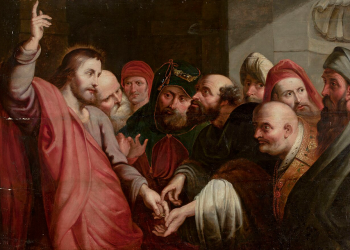
In Matthew 22:15–21, the question about paying taxes to Caesar was framed as an inescapable dilemma: either you are against Rome or you are against God. Jesus exposed this trap, showing that the issue is not about dividing two spheres of authority, as if God and Caesar were on the same level: the real question, in fact, is not to whom the coin belongs, but to whom the human being belongs—to whom we are called to give our lives.
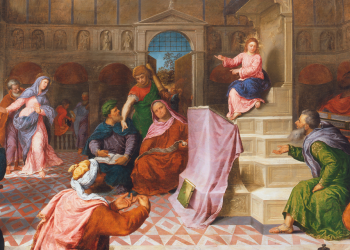
Several other controversies unfold in these chapters: The authority of Jesus (Mt 21:23–27), paying tribute to Cesar (Mt 22:15–21), the resurrection contested by the Sadducees (Mt 22:23–32), and today’s question about the Greatest Commandment. The questions may change, but the fundamental question remains the same: Who is Jesus?
Today’s answer is remarkable and leads us to the heart of the Law. Jesus does not simply quote the commandment that instructs us to love God (“He said to him, ‘You shall love the Lord your God with all your heart, and with all your soul, and with all your mind’" -Mt 22:37) which no teacher of the Law at that time would have objected to. But He immediately accompanies it with the love of neighbour: “And a second is like it: You shall love your neighbour as yourself” (Mt 22:39). He then affirms that “on these two commandments hang all the Law and the Prophets” (Mt 22:40). He does not choose one precept from among many but offers a key to understanding the entire divine revelation. Everything finds its meaning in the love of God and neighbour; everything must be understood and lived from this center.
As in the account of the tribute to Caesar, Jesus takes the question to a deeper level. His interlocutors seek an answer by which they can judge Him. He points to the center from which everything else must be reinterpreted. And this center is the love that unites the whole Law.
Jesus thus rejects the logic of reduction. He does not choose one side over the other, nor does he privilege one aspect at the expense of others; rather, he identifies the principle that gives unity and order to the whole.
There is another important detail. After answering, Jesus poses a question: “What is your opinion about the Messiah? Whose son is he?” (Mt 22:42). The dialogue then turns to the Messiah, the son of David, whom David himself calls 'Lord' (Mt 22:41–46). The question about the interpretation of the Law thus opens up to the question of the identity of the one who interprets it. Jesus invites his interlocutors to recognize in the Messiah a greatness that surpasses their expectations. This is a further invitation to recognize in the Messiah a dignity that surpasses that of the son of David alone and leads them to question the very identity of Jesus, the Son who came to bring the Law to fulfilment (Mt 5:17).
The commandment of love and the person of Jesus are deeply united. The love He presents as the center of the Law is the love He lives out in His relationship with the Father and in His free giving of self to humanity.
The dispute ends with the silence of His interlocutors. Matthew concludes: “No one was able to answer him a word, nor from that day on did anyone dare to ask him any more questions” (Mt 22:46). Not because Jesus had won a dispute.
Their silence stems from the fact that Jesus continually shifts the discussion from the level of interpretation to the level of its foundation. His interlocutors seek to debate the Law; He shows that He stands at the very source from which the Law comes.
The account thus leaves us with a question. This silence could have been the beginning of faith, like the silence of someone contemplating. Instead, it becomes the silence of those who refuse to let themselves be challenged.
Even today, we may find ourselves preferring to remain interpreters of the Law rather than becoming disciples of the Lord.
+Pierbattista
*Translated from Italian