12 July 2026
XV Sunday in Ordinary Time, Year A
With today’s Gospel passage (Mt 13:1–23), we begin our reading of the third discourse recorded by the evangelist Matthew—a discourse that brings together seven of Jesus’ parables, all of which share a single theme: the Kingdom of Heaven.
Jesus does not define what the Kingdom is; rather, he describes it and speaks of it through various parables that highlight its different aspects, the dynamics underlying its mystery, and its growth.
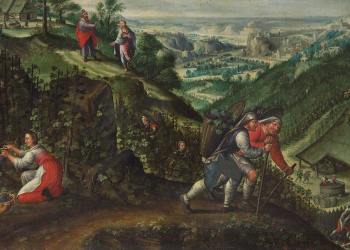
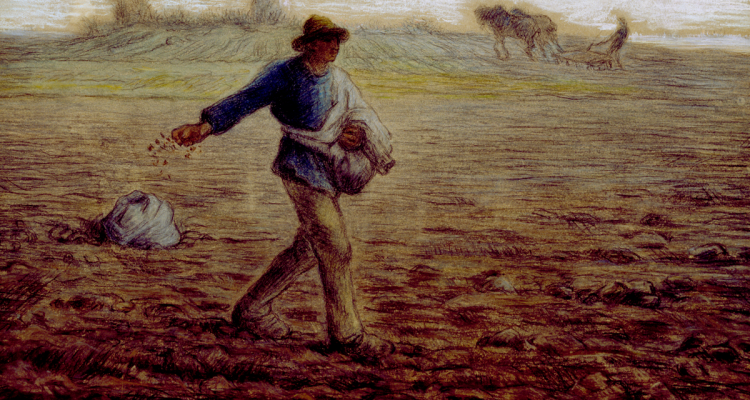
The parable we read today is the first and the longest one, the Parable of the Sower: a sower goes out to sow, scattering seed on different kinds of soil, some of which are more or less receptive to the seed and consequently they either bear fruit or fail to do so.
The great risk with this parable is that it might be read in a moralistic way: everyone pauses to reflect, identifies with a particular type of soil, and then tries to figure out how to become good soil.
But this interpretation does not do justice to the text of the parable, whose true protagonist is not the soil but the sower and, together with him, the seed. The decisive point of the parable is not the quality of the soil, but the generosity of the sower and his unconventional way of sowing.
It is precisely these characteristics, his generosity and his unconventional way, that reveal the Kingdom of God.
Let us therefore focus on some of the attitudes of this very special sower.
First of all, the sower goes out to sow without choosing the ground on which to entrust his seed. He never tires of sowing, even in places that appear barren.
He does not avoid the path, the rocky ground, or the thorns. He does not select, calculate, or optimize.
And this is because the Word does not judge the soil; it visits it.
And when he sees that in some soil the seed does not bear fruit, the sower does not change his strategy: he continues to sow everywhere.
And this is because it is not the Word that adjusts to the soil, but rather the opposite, as we will try to see: it is the Word that transforms the soil.
This is crucial: if the sower were to base his work on the condition of the soil, he would sow only in good soil; instead, he sows everywhere, and performs the same action on every kind of soil, even on barren ground.
One possible explanation for this anomaly might be that the fruit does not depend on the soil, but on the strength of the seed. Yet this interpretation is not supported by the text, which clearly states that some soils, for countless reasons, fail to receive the seed and therefore bear no fruit.
Why, then, sow everywhere? Because the seed of the Kingdom is precisely this: it is the proclamation of a God who speaks to everyone. It is the Good News that His Word is a seed of life for everyone, not only for some. There are no privileged ones and no outcasts.
This is the beauty of the Kingdom and the source of its strength: it is God's Word for everyone—for the poor, for sinners, for the little ones.
It is precisely the proclamation of such a Sower, of such a God, that awakens in everyone the desire to welcome His Word, because it is a word of compassion and mercy for all.
And so there is a possibility of transformation for every kind of soil, because the soil—that is, the human heart—is not a static place, but a dynamic one: it can change, and it changes when it is touched by a Presence that is gratuitous compassion, that is love.
Proof of the truth of this Christological—rather than moralistic—interpretation of the parable is found in the final verse: whoever hears the Word bears fruit—some a hundredfold, some sixty, and some thirty (cf. Mt 13:8, 23).
Even the good soil does not bear fruit in the same measure, but yields a hundredfold, sixtyfold, or thirtyfold. Yet it remains good soil. In biblical language, good does not mean perfect, consistent, or identical. It means receptive to the Word, capable of receiving it, and open to transformation. Good soil is humble soil.
A relationship with Jesus does not produce copies, but unique and authentic persons, each with their own story and their own fruitfulness.
The Lord welcomes this diversity as a place where the Kingdom is revealed. The variety of fruits is itself a manifestation of the life of the Risen Lord, who never repeats Himself in exactly the same way.
The parable does not, therefore, teach that we must be good soil, but rather that good soil is not so much a starting point as a destination—within a process that sets us free, that does not demand a perfect response, and that opens us up to life.
+Pierbattista
*Translated from Italian