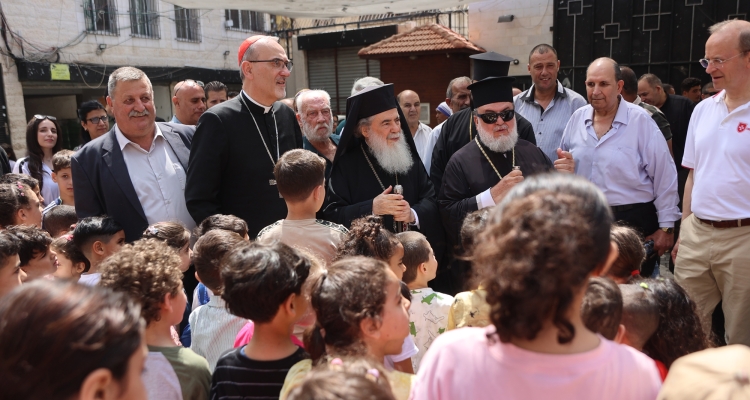


In a gesture of pastoral closeness and Christian solidarity, Patriarch Theophilos III of Jerusalem and Cardinal Pierbattista Pizzaballa, Latin Patriarch of Jerusalem, visited Gaza on June 22–23, accompanied by representatives of the Sovereign Military Order of Malta and Malteser International. The visit combined prayer, encounters with the local community, support for humanitarian and healthcare initiatives, and a renewed commitment to investing in Gaza's future despite the challenges.
The final day of the visit was marked by the graduation of 24 children from the Latin Patriarchate's kindergarten, where Cardinal Pizzaballa reiterated the importance of safeguarding the education and formation of the younger generation. "The first thing we have to do is think about our children and their future," he said.
A Ministry of Presence and Consolation
The Patriarchs arrived in Gaza on June 22 carrying with them the prayer of the faithful from all over the world, and Jerusalem, expressing their continued closeness to Gaza’s wounded faithful and to all those affected by the ongoing crisis.
Their presence embodied a “ministry of consolation, mercy, and steadfast Christian witness, rooted in the Gospel and in the sacred vocation of the Holy City,” as stated by the joint press release.
Upon their arrival, the parishioners and members of the local community warmly welcomed both Patriarchs at the Greek Orthodox Church of Saint Porphyrius, and then at the Holy Family Parish, who gathered in the courtyard to greet them and present the delegation with flowers, in a gesture of gratitude. Addressing those gathered, Cardinal Pizzaballa conveyed the greetings and prayers of the Church of Jerusalem, emphasizing that it was important to make the visit together with Patriarch Theophilos III as a sign of the unity of the Churches and their shared commitment to the Christian community.
“We never abandoned you and you’ll never be abandoned, The Christian community in Gaza will always remain our concern and our responsibility,” said their Beatitudes upon their arrival. “We are rooted here and will remain here. Do not be afraid. The situation is difficult, but we face it together”.
During the visit, the Patriarchs also met families in their homes and temporary residences, checking up on them, and offering spiritual encouragement amid the hardships they continue to face.
The first day concluded by presiding over Eucharistic Celebration at Holy Family Parish. In his homily, H.B. Cardinal Pizzaballa reflected on the resilience he encountered among the people of Gaza and invited the faithful to see one another with God’s gaze, a gaze that sees with the heart.
“War does not excuse us from living out the Gospel,” he said. “It does not change our behaviour, our relationships with one another, or our relationship with others.” Encouraging the community to respond not with judgment or fear, but with compassion and generosity. "If someone asks you to go one mile, go two miles," he said. "This is what is required of us, even in Gaza."
Education and Dialogue: Sowing into the future
The visit also highlighted the Churches’ dedication to the formation of future generations, and providing education. As H.B. Card. Pizzaballa, repeatedly said in previous visits that there is no future without education.
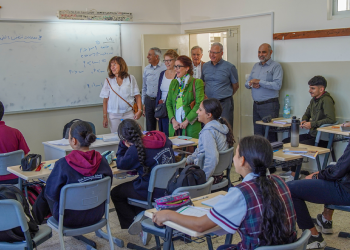
During the first day of the visit, Cardinal Pizzaballa blessed a newly renovated house that will expand the kindergarten’s capacity for the coming school year. In his speech, he thanked all those working on the ground, the teachers, and staff. And expressed his hope that efforts would continue so that more students have access to education:
“Next scholastic year is approaching, preparations are underway to provide as many young people as possible with education,” he said. “Children who have seen so many terrible things need to encounter beauty again. We believe in the providence of God; He who willed for us to be here, did not bring us here by chance, rather, He calls us to work together to do something beautiful in this land. Gaza is not only war—it is also love and a desire for life”.
The Latin Parish in Gaza has tried its best to ensure that children received a form of education, "It is not something to be taken for granted that, amid everything that is happening, you have chosen to continue to offer education," he said during the graduation ceremony. "In a context like this, we learn to appreciate what in normal times we often take for granted. I congratulate the Latin Patriarchate schools, first of all because you continued your mission even during the war, and now because you have decided that this is not enough—you want to grow and reach as many students as possible. This is our duty toward them. Children are the same everywhere: they need the same things, they have the same fears, and they need the same love."
Meeting University Students
Cardinal Pizzaballa’s also visit Al-Azhar University of Gaza, where he participated in a lecture on “Interreligious Dialogue and the Values of Coexistence and Peace,” attended by university leaders, religious figures, civil society representatives, and students.
“This is a small sign but important symbol and sign of peace”, said the Card. Pizzaballa as he planted an olive tree at the University. “we need signs and symbols to remind us how important it is to place the seed toward peace.”
The Cardinal emphasized that dialogue between religions is a human and moral necessity, especially in times of conflict. He highlighted shared values such as human dignity, justice, mercy, and love as foundations for peace.
“Hatred is more dangerous than bombardment because it generates violence,” he said. “We all have a responsibility to resist it.”
Addressing students, he encouraged them to remain committed to rebuilding their society.
“You, the youth, are the ones who will rebuild Gaza, where there is a will there is a way.”
Supporting the Healthcare sector
During the visit, the Patriarchs blessed a new healthcare clinic established through a partnership between the Sovereign Military Order of Malta and the Latin Patriarchate of Jerusalem. As stated in the statement issued by the Sovereign Order of Malta: “Following this blessing, around thirty staff members, including doctors, nurses, and pharmacists, will begin providing primary health care to up to one hundred sick people every day. Its activities are coordinated by Malteser International, the Order of Malta’s humanitarian aid agency”.
Dr. Josef Blotz, described the blessing of the clinic as "a historic milestone," noting that more than 900 years after the Order of Malta foundation in the Holy Land, it continues to serve those in need regardless of religion or background. "This clinic will provide lifesaving medical care to people in need and show them that they are not forgotten," he said, reaffirming the Order's commitment to expanding its humanitarian presence in Gaza.
The clinic opens at a time when Gaza's healthcare system remains under severe strain. According to recent World Health Organization assessments, only about half of Gaza's 36 hospitals remain partially operational, while none are functioning at full capacity. "Medical care for people in Gaza is currently in a catastrophic state," said Dr. Ali Ibrahim Al-Musaddar, Medical Director of the clinic, all hospitals in the Strip have sustained some level of damage, and critical shortages of medicines, medical supplies, and equipment continue to disrupt essential services.
During the visit, Cardinal Pizzaballa also visited Al-Ahli Arab Hospital, St. John of Jerusalem Eye Hospital, and Caritas Jerusalem’s team in Gaza, where he received briefings on their most urgent needs and the services they continue to provide to the local population. He reaffirmed the importance of sustaining humanitarian and medical assistance for all those affected by the conflict.
A visit of Solidarity, closeness and friendship
For both Patriarchs, the visit was an opportunity to accompany Gaza's Christian community and reaffirm the Churches' closeness. The blessing of a new kindergarten facility and healthcare clinic reflected a commitment not only to addressing urgent needs but also to investing in Gaza's future. As Cardinal Pizzaballa remarked, it is necessary "to organize something altogether for the future of this wonderful place, despite everything."
Concluding with a message of hope, Cardinal Pizzaballa looked toward a future in which Gaza's schools, hospitals, and communities can flourish once again.