August 2, 2026
XVIII Sunday in Ordinary Time, Year A
This Sunday’s Gospel reading (Mt 14:13–21) begins with a reference to the death of John the Baptist (Mt 14:13), which is recounted before today’s passage. By comparing these two passages together, we find a key that helps us understand today’s meditation.
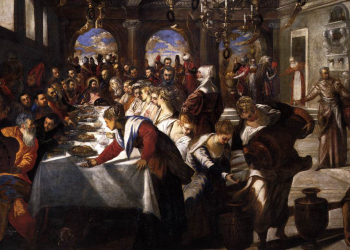
We come to find two banquets: the banquet of Herod (Mt 14:6–11) and the banquet of Jesus (Mt 14:19–21).
At the first banquet, a liturgy of violence and power unfolds, in which each person pursues only their own objective and self-interest. Every character at Herod's banquet acts for personal gain: Herod uses the banquet to reinforce his public image; Herodias uses her daughter to obtain the revenge she desires; the young girl uses her dance to please her mother; the guests take advantage of the situation in order to remain in the king's favour. The result of this banquet is the death of John the Baptist, because wherever power is exercised for oneself and against others, someone inevitably pays the price for all, and no one truly finds life.
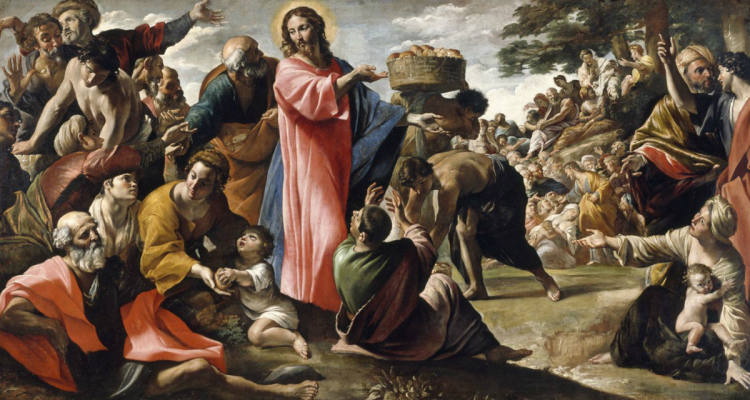
Alongside this banquet, however, Matthew paints the second panel of the diptych. We are no longer in Herod's palace, but in a deserted place ("Jesus withdrew in a boat to a deserted place by himself" – Mt 14:13). There are no privileged, carefully selected guests, but rather a great crowd following Jesus on foot wherever He goes, bringing their sick with them. There is no king afraid of losing his power; instead, there is a King moved with compassion, who prepares for His guests a banquet that is abundant and, above all, freely offered (Mt 14:19–20).
What sets these two banquets apart is the logic that lies beneath them.
The logic governing Herod's banquet is a logic of exclusion. It leaves room for only one possibility: either me or you.
Once the other person is viewed as a threat, someone who might take away what I possess, then, in order to defend myself, I eliminate them.
It is exactly the same logic Matthew recounts in chapter 2, where we encounter another Herod—Herod the Great—who, when he feels threatened by the announcement of the birth of the King of the Jews, orders the killing of all the boys two years old and under. To preserve his own life, he destroys the lives of others.
The logic that gives life to Jesus' banquet is entirely different, and it can be summed up in a single word: compassion. Jesus steps ashore, sees the great crowd, and is moved with compassion for them ("He had compassion on them and healed their sick" – Mt 14:14).
Compassion is the exact opposite of the logic of power that we have seen at Herod's banquet. Jesus sees the crowd and recognises them as part of Himself; therefore, He takes upon Himself their suffering and, instead of defending Himself, He responds with a gesture that generates life. Jesus does not remain at a distance as a mere observer: for Him, the crowd is neither a burden nor a threat, but an appeal—a call that concerns Him personally and asks Him to give the only thing that can truly heal, the only real medicine for everyone: the free gift of His love.
This is a logic that never sets one person against another. It never asks that one be sacrificed for the sake of another. On the contrary, it values each person for who they are and for what they have, even if it seems very little—just as little as the loaves and fish the disciples have available ("Five loaves and two fish are all we have here" – Mt 14:17).
Jesus enters into that little. He takes it into His hands, blesses it, gives thanks, breaks it, and gives it away (Mt 14:19).
He takes what humanity offers and makes it the means through which His love is revealed, where His compassion takes flesh.
God does not replace humanity; rather, He acts together with us and through us.
It is, after all, the very logic of the Incarnation: God does not oppose humankind; He Himself becomes human, and in this way sustains and saves us.
+Pierbattista
*Translated from Italian