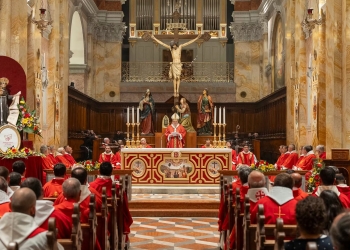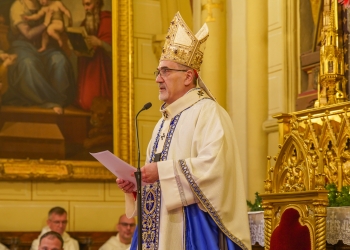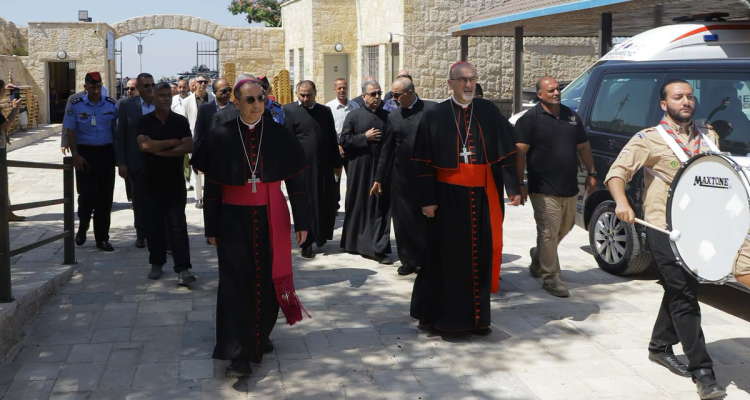

Hundreds of faithful from across Jordan and abroad gathered at the Shrine of the Prophet Elijah in Ajloun on Friday, July 24, to celebrate the Feast of St. Elijah, one of the Holy Land's great prophets. The solemn Eucharistic celebration was presided over by His Beatitude Cardinal Pierbattista Pizzaballa, Latin Patriarch of Jerusalem, and concelebrated by Msgr. Iyad Twal, Patriarchal Vicar in Jordan, together with numerous priests.
Nestled among the hills of northern Jordan, the Shrine of the Prophet Elijah is one of the country's officially recognized Christian pilgrimage sites. According to local Christian tradition, it marks the birthplace of the Prophet Elijah in Tishbe of Gilead (cf. 1 Kgs 17:1). Archaeological remains of Byzantine churches discovered at the site testify to centuries of Christian veneration, making it a place where pilgrims continue to encounter the biblical heritage of the Holy Land and reflect on Elijah's enduring witness.
Reflecting on the significance of the place, Cardinal Pizzaballa emphasized the importance of mountains in the Bible and the life of the Faithful.
"We are gathered here in this beautiful and authentic place to celebrate on this mountain. Throughout Sacred Scripture, mountains are places of encounter with God, places where He reveals Himself. We all need to have our own 'mountain'—a place where we can be alone with Him. It may be our home or any place where we can truly encounter the Lord."
Drawing from the life of St. Elijah, Cardinal Pizzaballa reflected on two essential lessons for Christians today.
First, he spoke of Elijah's unwavering fidelity to God. During a time when most of God’s people had turned to idols, Elijah remained faithful despite persecution and isolation.
"He did not follow the stream, or the mentality of his time but remained faithful to the Word of God, paying a personal price for that fidelity. We too have our idols today. Each of us must decide, not only once in life but every day, whom we choose to follow—God or the idols of our time. This choice touches every aspect of our lives: our families, our work, our schools, and our daily decisions."
The Patriarch acknowledged that faithfulness often entails suffering and unanswered questions.
"Like Elijah, we can feel alone or abandoned at times…especially when we do not receive immediate answers to our questions. To remain faithful also means learning to wait with trust until God's answer comes."
Secondly, Cardinal Pizzaballa reflected on God's own faithfulness to His people.
"God not only asks us to be faithful; He Himself is always faithful. Elijah endured hardship, persecution, and the desert, yet God never abandoned him. He sent people to sustain him and gave him strength to continue."
Concluding his homily, the Patriarch reminded the faithful that Elijah forms part of Jordan's spiritual heritage.
"Here in Jordan, Elijah is part of our heritage; he is one of our own. But it is not enough to say that he belongs to us. We must also follow his example and become part of his story. May the intercession of St. Elijah help us always remain faithful to God and recognize His faithfulness in our own lives."
Among those present were representatives of Jordan's Ministry of Tourism and Antiquities, led by H.E. Dr. Imad Hijazin, together with officials from the Jordan Tourism Board, who supported the organization of transportation for pilgrims from various parishes. Also in attendance were the Governor and Deputy Governor of Ajloun, representatives of local civil, religious, and archaeological institutions, clergy from the Ajloun region, including Fr. Salam Haddad, parish priest of St. Elijah in Ajloun; Fr. Johnny Bahbah, parish priest of St. Paul in Ajloun; and Fr. Yousef Francis, parish priest of Our Lady of the Mountain in Anjara.
Gathered at this holy site, the faithful celebrated the witness of the Prophet Elijah and were reminded that, just as God remained faithful to His prophet, He remains faithful to His people today. Renewed by this encounter, they departed with a deeper commitment to live the Gospel in their daily lives.