May 24, 2026
Solemnity of Pentecost, Year A
The Gospel passage we hear on this Solemnity of Pentecost (Jn 20:19–23) takes us back to the evening of Easter Sunday, and this is the first key point we need to dwell on.
To “understand” Pentecost, we must go back to Easter, because the Spirit is the very life of the Risen One, given to the disciples.
The evangelist John wants to make it clear: the Spirit is not an addition after the Resurrection. The Spirit is the very essence of the risen life. The Lord cannot help but give Him, for He is His own life, and life always seeks to be shared with others. This is why John places the outpouring of the Spirit on the very day of the Resurrection: to say that Easter is already Pentecost in seed
But also to say that Easter, in a sense, would not be “complete” without Pentecost.
The Father’s plan, is for humanity to live the life of the Son: well, Easter makes this life possible, while Pentecost puts it into effect, activates it, and makes it transferable.
Resurrected life does not belong solely to the Risen One, nor does it wish to remain closed off and reserved for the few: it becomes the Church, the Body, a language for all.
And this takes place during a gathering that occurs in the Upper Room on the evening of that same day, the first day of the week (On the evening of that first day of the week, when the doors were locked, where the disciples were, for fear of the Jews, Jesus came and stood in their midst and said to them, "Peace be with you." - Jn 20:19)
On one hand we find the Risen One, filled by the Father with a life that overflows, a life that is eternal fullness. On the other hand, there are the disciples: fragile, closed in on themselves, fearful, unable to look to the future, marked by failure and flight. They are alive, but with limited constricted life, its light about to be put off.
And yet, it is within this contrast that the encounter takes place. The Risen One does not ask the disciples to change their state of being, rather, he enters into their wounds, not their strengths; he dwells amid their fear, not their faith; he shows them His wounds, not His glory. In this encounter, Life does not judge fragility, but reaches out to it and transforms it from within. The gift of the Spirit is founded here: the life of the Son who bends over the lives of His people, marked by sin, to lift them up.
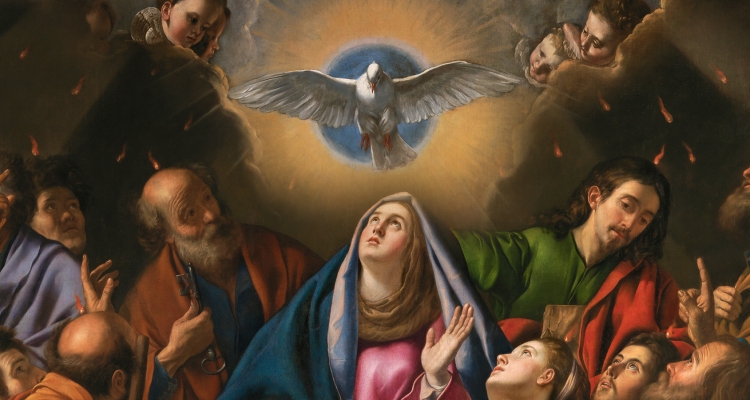
To those who are fragile, the Lord does not simply offer help, advice, or encouragement. He does not stop at accepting them as they are. To these fragile people, the Risen One gives His very own life. That full, abundant, eternal life—the life he received as a gift from the Father—the Risen One pass to His own, through a gesture and a word that mark a transition, a bridge allowing this life to reach the Church: “He breathed on them and said to them, 'Receive the Holy Spirit’” (Jn 20:22).
This is not a symbolic gesture: it is the actual passage of divine life into human life. A life marked by three characteristics.
First, it is a life reconciled
The first effect of the Spirit is forgiveness: “Whose sins you forgive are forgiven them.” (Jn 20:23). The life of the Risen One revives what is dead and cares for what is sick.
Sin, in biblical language, is not a moral stain: it is a zone of death, a place where relationship has been broken, where the heart has closed and life no longer flows. When the Risen One gives the Spirit, the first thing that happens is that life enters the dead zones. This is what forgiveness is: life returning where there was no longer life, and everything has the chance to blossom anew, to begin again.
Second, the life of the Risen One, is a life sent forth: “As the Father has sent me, so I send you” (Jn 20:21). The Spirit does not enclose, withdraw, or isolate. The Spirit opens up, expands, and sends.
That is why new life cannot be kept as a personal treasure: it is a life that naturally reaches out and for others, just as the Son sought us.
Mission is not a duty added to the Christian life: it is the very life of the Spirit moving within us, it is a participation in God’s movement toward the world, in His passion for humanity.
Finally, new life is a life inhabited by God.
The Risen One does not stand outside: he enters, stands among them, and breathes on the disciples (“he stood in their midst” … “he breathed on them and said to them, ‘Receive the Holy Spirit’” – Jn 20:19, 22). It is not merely a better life, but a life in which God makes His home. The Spirit is not an external aid; he is not a force that comes occasionally, or frequently for the more fortunate. He is a stable presence, like someone who has taken up residence within our humanity.
These three elements of the new life are also criteria of discernment with which to interpret what happens within and around us, and at the same time to recognize how and where the Spirit is at work: wherever something is reconciled, there the new life passes; whatever opens us up, decentralizes us, and leads us out of ourselves comes from the Spirit; wherever an inner presence grows that brings peace, enlightenment, and direction, there the Spirit dwells.
+Pierbattista
*Translated from the original in Italian