15 november 2026
XXXIII Sunday in Ordinary Time, A
“Share your master’s joy". (Mt 25:21, 23).
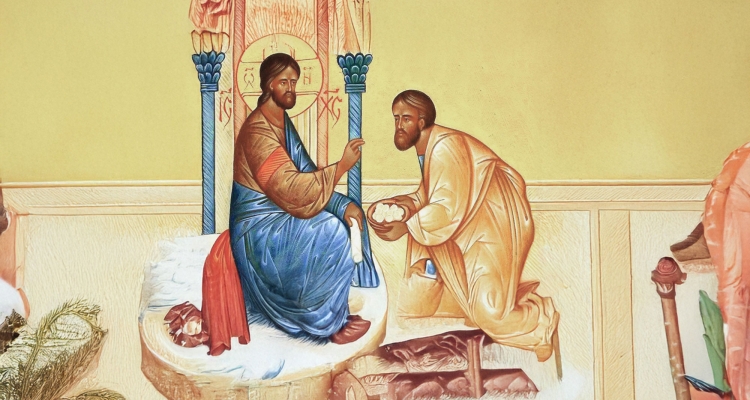
These are remarkable words that the master addresses to the servants who bore fruit from the talents the Master entrusted to them prior to His departure (Mt 25:14–15). He does not merely take back what is rightfully His, nor does He simply compliment them, thank them, or reward them for their work. Rather, He shares His joy with them.
We are accustomed to reading the parable of the talents (Mt 25:14–30) in terms of responsibility: God entrusts us with gifts, and we must put them to good use. This is certainly a valid interpretation, but it risks being reduced to a moralistic exhortation: we have received something, so we must work hard and achieve results.
On the other hand, If we interpret it from the master’s joy, the perspective changes: the servants are not simply called to produce something for their master, but to share in His joy. Therefore, there is a form of joy—God’s joy—that every person is called to partake in it, and to delight in it.
We are not merely servants carrying out His commands, but people to whom God desires to offer His own joy.
But how does this participation take place? How do we enter into God’s joy?
The parable tells us first of all that the servants do not work to earn the master's favour: He already trusts them, since he has given each of them a portion of His possessions.
He does not give everyone the same number of talents, but distributes them “to each according to his ability” (Mt 25:15).
Not everyone, therefore, receives the same quantity, but everyone receives something and is part of the same relationship of trust.
The parable then tells us that, in order to share in the master’s joy, we must make His gifts bear fruit (Mt 25:16–17). It is not simply a matter of preserving them: the first two servants, in fact, without waiting for further instructions, go and put the talents to work, earning back just as many. They are not custodians of an inheritance, but protagonists in a story that begins with a gift received.
God does not entrust something to us so that, in the end, we might return it to Him intact. He entrusts it to us so that, through it, we may grow and become who we are meant to be. In the end, it is not only the quantity of the talents that changes, but also those who have received them.
The servant who puts the gift to good use gradually becomes capable of greater responsibility: from little, he moves on to much. “Since you were faithful in small matters, I will give you great responsibilities” (Mt 25:21, 23).
The talent entrusted to him thus becomes part of the servant’s personal story: he has welcomed it, made it bear fruit, and invested his very life in it. It is no longer merely something he possesses; it is something that has helped shape him into who he is.
Yet, the parable tells us that there is someone who does not enter into the joy of his master (Mt 25:30).
He does not enter into it, not because he has achieved little, but because he has lived his relationship with his master in fear. His own words are revealing: “…I was afraid” (Mt 25:25).
It is this fear that paralyzes him, prevents him from taking risks and from trusting, it even holds him back from assuming responsibility for the gift he received.
He safeguarded the talent, but he was unwilling to take a risk in the relationship
The third servant sees the master in a completely different light from the other two: in his eyes, he is a harsh, demanding, and threatening man: “Master, I knew you were a demanding person, harvesting where you did not plant and gathering where you did not scatter” (Mt 25:24). The difference between the servants, then, lies not merely in how they manage the master's possessions, but in the image of the master they hold within themselves.
Behind the servants’ behaviors lie two different perceptions of God, and from these arise two opposing ways of living.
The first two servants do not express their understanding of the master; they simply act without allowing fear to paralyse them. Knowing that God is good is not enough. This trust must become the very foundation of our decisions and actions.
The third servant thinks he can protect himself by simply keeping what he has received. Yet, in doing so, he fails to truly live his relationship with the master and ends up losing everything.
Perhaps this is precisely the conversion to which we are called: to move from a life lived out of fear of disappointing God to a life lived in trust in Him; to move from the fear of losing something to gratitude for the immensely precious gift we have received.
+Pierbattista
*Translated from Italian