September 6, 2026
XXIII Sunday in Ordinary Time, Year A
Mt 18:15-20
The problem of evil is a prominent theme in the Gospel of Matthew, especially in Jesus’ five major discourses.
It recurs frequently in the Sermon on the Mount, in the mention of the weeping and persecution (Mt 5:4, 10), of adversaries, scandals, and enemies (Mt 6:25, 29, 44).
It also recurs in the parables (Mt 13), where we see the evil one stealing the seed (Mt 13:19), where weeds grow alongside the wheat (Mt 13:25), and where, in the net, we find both good and bad fish (Mt 13:48).
Evil is never viewed in the abstract sense. Ultimately, it is always a result of failure in listenening, a rejection of relationship with God and with our brothers and sisters.
And Jesus’ teaching is always the same: he does not explain evil, nor dwell on where it originated from, but shifts the focus to what is at stake, and then sees how to confront it: what is there to be healed and how to heal it when evil attacks the community of disciples.
In today’s Gospel (Mt 18:15-20), which is taken from Jesus’ fourth discourse in Matthew’s account, known as the discourse on the ‘community’ or the ‘ecclesial’ discourse. Jesus first explains what not to do: when a brother commits a fault against another member of the community, there are certain things we should not do.
The first is not to be scandalized, as though the evil that wounds communion should not exist. Jesus speaks of it as a real possibility, one that can arise from the heart of any member of the community, without exception. The second is not to blame the person who has done wrong, not to burden them with a sense of guilt, and not to treat them as an enemy: we must not abandoned them.
But neither should we give up, withdraw, pass the responsibility on to others, or hide, allowing evil to work within the community until it divides and weakens it.
On the contrary, according to Jesus’ logic, the evil that befalls the community because of a brother’s mistake can become an opportunity for everyone to work together, to love one another more deeply, because communion is never something to be taken for granted, but must be safeguarded and built through a journey of truth, sensitivity, and responsibility.
Jesus, first and foremost, makes the ultimate goal clear: to win over one’s brother (“…If he listens to you, you have won over your brother” – Mt 18:15). The goal, therefore, is not to restore justice or to repay the offense one suffered. Because an offense can be said to be repaid only when communion has been restored, not when it has been decided who is in the wrong and who is in the right.
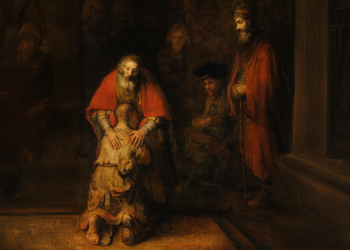
Once it is clear that this is the goal, the road toward attaining it is described in the verses prior to today's passage, in the parable of the lost sheep (Mt 18:12-14): if a man has a hundred sheep and one of them goes astray, will he not leave the ninety-nine on the mountains and go in search of the one that is lost? And the parable concludes with a key that helps us understand: “In just the same way, it is not the will of your heavenly Father that one of these little ones be lost.” (Mt 18:14).
Today’s passage offers us a twofold challenge. First, it invites us to consider the way we look at our brother who has committed a fault. The parable suggests that the right way to see this brother is as the lost sheep: he is not an evil brother; he is a brother who has gone astray. It is a perspective that completely changes our point of view.
It is also important that the action taken be practical: every effort needs to be made to bring the brother back into the community, just as a shepherd does everything he can to bring a sheep back to the fold. We should too go out to look for the brother and create the conditions that will enable him to return home.
Evil, therefore, must be confronted in only one way: the way the Father confronts it, driven by a single priority: that no one should be lost. Thus, correction is never merely a rebuke, but an attempt at restoration, a Paschal movement: bringing back to life that which is at risk of being lost. At the end, however, each person is free to choose for themselves, including the free choice to remain outside the community (“…If he refuses to listen even to the church, then treat him as you would a Gentile or a tax collector.” – Mt 18:17).
The criterion, nevertheless, is clear: to safeguard the brother, to safeguard the relationship, means safeguarding the presence of Christ in the midst of the community.
Verse 20 represents the culmination of the passage: “Where two or three are gathered in my name, there am I.”
The Lord’s presence is not automatic; it is not guaranteed by the structure, but by the quality of relationships.
It is not a reward offered to those who are good, but the fruit of a journey of reconciliation and peace, which is a participation in the very life of the Risen One.
+Pierbattista
*Translated from Italian