16 August 2026
XX Sunday in Ordinary Time, Year A
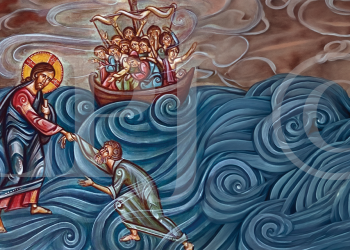
Last Sunday (Mt 14:22–33), we saw that the experience of faith comes through the courage to dare to do something new—something that goes beyond our own abilities and standards.
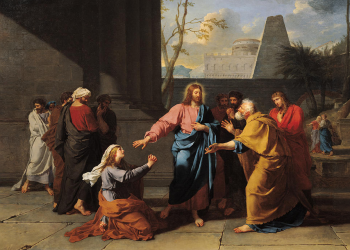
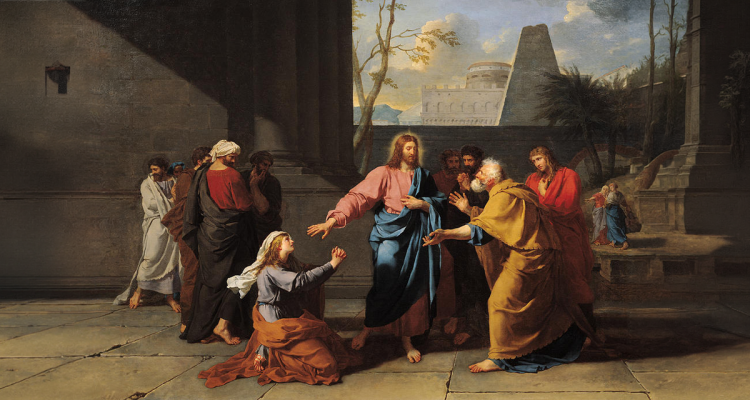
Today, too, we are faced with something similar. Last Sunday, we saw Peter dare to step out of the boat and walk on the water towards the Lord. In this Sunday’s Gospel passage (Mt 15:21–28), we see a foreign woman who dares to enter into the history of salvation.
Two figures who are somewhat different, but united by one decisive trait: a faith that takes risks, a faith that dares. The Canaanite woman, in fact, dares greatly.
First of all, the woman dares to enter into the space of Israel: we are told that she is a Canaanite woman, who came from that district (“And behold, a Canaanite woman of that district came and called out...”—Mt 15:22). She is a woman who sets out and begins her journey, just like all believers. She is a foreigner, excluded, not part of the promise, and yet she draws near: she does not remain on the margins; she does not accept being kept at a distance. Her first act of faith is not to allow herself to be defined by boundaries.
She does not know it, but through her gesture she is saying that the Kingdom of God is not a closed enclosure, but an open space, to which everyone can draw near.
The woman dares to cry out (“she began to cry out…” – Mt 15:22). She does not speak, she does not ask, but cries out, like the psalmists, like the afflicted who know that God hears the poor and has a special love for them. She is not afraid to disturb others or to show her pain, and she believes that this good teacher will be moved by the cry that rises from her suffering.
The woman dares to call Jesus by a messianic title that, in the Gospel of Matthew, no other foreigner dares to utter: “Lord, Son of David!” (Mt 15:22). This means recognizing that the promise made to David—and before him, to Abraham—applies to her as well. She, who is not an Israelite, recognizes herself as part of this story, with a sense of belonging that clings to a blessing that, from the very beginning, was intended for everyone. She is foreshadowing the Church of the Gentiles, the one that will be born at Pentecost and whose only door is faith.
The woman dares to stand firm in the face of Jesus’ silence, without interpreting it as a rejection. In fact, when faced with her cry, Jesus initially remains silent (“But he did not say a word to her”—Mt 15:23), yet the woman does not flee or give up: she remains there, waiting for a word. On the contrary, Jesus’ silence becomes, for the woman, an opportunity to draw even closer: “But she came forward and knelt before him” (Mt 15:25). The woman is able to transform waiting into faith. She does not flee even when Jesus’ words finally come—though they are harsh: “It is not right to take the children’s bread and throw it to the little dogs” (Mt 15:26). It is a statement that could wound, shut her out, and extinguish her hope.
She, on the other hand, dares to engage with the parable Jesus used; she embraces it and takes it further: “That is true, Lord, yet even the dogs eat the crumbs…” (Mt 15:27). She does not reject what Jesus tells her; she does not take offence, but enters into His language and into the logic of the Kingdom, as if entering a bountiful and freely given banquet. She does not ask for the bread, but for the crumbs, and believes that even these alone are enough to satisfy and heal.
Jesus, too, dares: he accepts listening to this woman, dares to speak with her, and recognizes in her a truly great faith (“Woman, great is your faith!” – Mt 15:28).
A faith that not only obtains the healing of her daughter, but also gives the Lord the opportunity to broaden the scope of his mission.
In both cases—that of Peter and that of the Canaanite woman—the act of daring opens a path and allows the Lord to reveal Himself further.
Peter allows Jesus to reveal Himself as the Son of God, as the Emmanuel who reaches out and saves.
The woman gives Jesus the possibility of fulfilling, through her, His vocation to reveal himself as the One who goes beyond boundaries and gives the blessing of God to all peoples.
+Pierbattista
*Translated from Italian