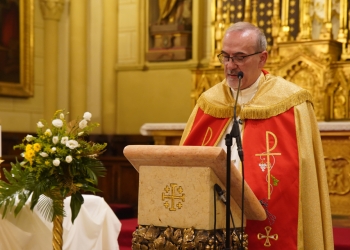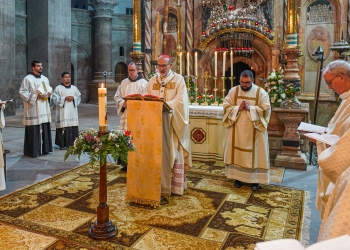
Fribourg Cathedral November 15, 2025
33rd Sunday in Ordinary Time (Lk 21:5-19)
Your Excellency, Brothers and sisters, May the Lord give you peace!
Today's Gospel takes us to the heart of Jesus' eschatological discourse, a word that pierces the veil of time and speaks directly to our present day. It all starts with a human, all too human perspective: some, as often happens to us, admire the beauty of the temple, its large stones, its rich ornaments. It is a perspective that focuses on human greatness, on the security that comes from the works of our hands. But Jesus surprises and shocks with a prophecy that surprises his listeners: "The days will come when there will not be left here one stone upon another that will not be thrown down" (Lk 21:6). These are harsh words, announcing the end of a world, of a way of understanding religiosity, of an entire era. We too, brothers and sisters, have the impression that we are at the end of an era, disoriented by the dizzying speed of social and cultural changes, and even within the Church. The Gospel, however, does not leave us in confusion; it gives us a fundamental indication, a compass of trust and hope.
Just when everything seems destined to collapse, Jesus opens up a new, eternal perspective: not everything will end. There is something, indeed Someone, who remains, who resists the hardest trials. These words resonate today with prophetic power and very real pain in the Holy Land. As we speak, that land, which should be a living icon of communion and a tangible promise of peace for the whole world, is torn apart by a tragedy that seems to have no end. The rubble we see—and which our brothers and sisters tread on every day—is not only that of destroyed houses, hospitals, and roads; it is not only the unspeakable number of innocent victims. Perhaps even more painful are the ruins of broken relationships, betrayed trust, and interrupted dialogue. War has carved deep furrows in hearts, generating hatred that risks becoming a poisoned legacy for future generations. The dialogue between religions, already fragile, now seems almost a distant mirage: the courageous voices that, in the midst of the conflagration, call for reconciliation and justice are often drowned out by the roar of weapons and the excruciating bitterness of mourning. A bleak picture, humanly speaking.
Yet it is precisely in this abyss of desolation that the Lord repeats to us forcefully: "This is not the end."
Jesus, in the Gospel, does not hide the truth from us: he does not sugarcoat the reality of evil. He speaks clearly of wars and revolutions, of earthquakes and famines, of persecutions, betrayals, and hatred. All that is most terrible and dark that can happen in human history. And today, unfortunately, we do not need to strain too hard to imagine these words: we need only look at our Holy Land, wounded by age-old conflicts, lacerating divisions, tensions that seem insurmountable. Faced with all this, it is natural to think that resistance is impossible, that hope is madness. And yet, in this very context, Christ's shocking promise resounds: "Not a hair of your head will be lost" (Lk 21:18). These words do not mean a magical immunity from pain and death—Jesus himself says that some will even be killed (Lk 21:16)—but they tell us that all this pain, this violence, this death, do not have the last word. It is not the end of faith, it is not the end of hope, it is not the end of love. From these ruins, like the sprout from the seed that dies, something new can and must be born.
The Gospel, like a map for the soul, shows us today three concrete ways not to succumb, three paths of spiritual resistance:
- Trust Rooted in God Those who believe, to the very end, that the Lord has not abandoned history to chaos will resist. Those who know with unshakeable certainty that God is particularly close to those who suffer, to those who are persecuted, to those who are discarded. It is He who, in the moment of greatest trial, gives a "word and wisdom" (Lk 21:15) that do not come from human fear or the calculating prudence of the world, but from the Holy Spirit. This trust is not a vague feeling; it is the strength of spirit that sustains Christians in Gaza, the West Bank, and Jerusalem: small communities that, in a context of overwhelming minority and widespread conflict, continue to pray, celebrate the Eucharist, and hope against all hope, even when everything around them cries out in despair. Trust means clinging to the illogical, scandalous conviction that peace is still possible, even when it seems like the most distant dream.
- A New Outlook, Purified by Faith It is not a question of being naive, but of not stopping at the superficial gaze that sees only the stones falling. At the beginning of the passage, there is the gaze that admires the appearances of the temple; then Jesus warns against the gaze that allows itself to be deceived by false messiahs and prophets of doom (Lk 21:8); finally, he shows us the gaze of the believer, who knows how to see, within the upheavals of history, a unique opportunity for witness (Lk 21:13). Even today, amid the social tensions of our cities, the divisions in our communities, and the prejudices we carry within us, we are called to be concrete signs of peace, dialogue, and hope. A new perspective is one that, following the example of so many priests, religious, and laypeople in the Holy Land, sees in our neighbor of another faith not an enemy to defend ourselves against, but a brother or sister with whom to build a different future. It is the perspective of Catholic schools in the Middle East, which educate Muslims and Christians together, sowing seeds of peace in arid soil.
- Active Perseverance that Saves Lives "By your perseverance you will save your lives" (Lk 21:19). Evangelical perseverance is not passive resignation, "enduring" until it is over. It is active "remaining," positive "resistance." It is the choice not to flee from complexity, but to remain, to pitch the tent of love right where the darkness seems thickest. A life that is lost, spent, given for love, is the highest and most powerful witness that can be given. This is how life is "saved": not because it has escaped physical death, but because it has become a gift, like the life of Christ. Persevering today, for us as for Christians in the Holy Land, means stubbornly continuing to build bridges where others erect walls, to educate children to encounter rather than clash, to pray for those who hurt us, to believe that forgiveness is the only force that can break the endless chain of revenge.
The temple in Jerusalem, made of stone, has collapsed. But the life given for love, the gestures of heroic charity, the prayers raised in the churches of Bethlehem or Nazareth, remain for eternity. It is worth fixing our gaze on this life, on the life of Christ offered in every Eucharist celebrated in those tormented lands, as on something that even the most violent death cannot destroy.
In this Holy Land, marked by ancient wounds and a tenacious, poignant hope, we are all called to be witnesses of this trust, this new outlook, this perseverance. Right there, where the Lord Jesus, with his body on the cross, broke down forever the wall of hostility that divided peoples (cf. Eph 2:14), we are called to believe, to the very end, that peace is possible, even if every historical event seems to point in the opposite direction. Despite everything, the Church in the Holy Land – with its bishops, priests, religious and lay faithful – continues to be a sign of tenacious hope, an uncomfortable voice that invites prayer and conversion of heart, so that hatred and violence do not have the last word. Jesus' promise – "Not a hair of your head will be lost" – is stronger than any rubble, any r bomb, any hate speech: it is the divine guarantee that history, our history and that of the world, is not abandoned to chaos, but is kept safe in the loving and providential hands of God.
May our community here, in turn, become a credible sign of this peace, a concrete place where the word of Jesus takes flesh: it is not the end, but the beginning of something new. Amidst the wounds of the world, we are called to be witnesses of trust, of a new outlook, of perseverance. Because true peace, we know, does not come first and foremost from political treaties, but springs from hearts that humbly allow themselves to be transformed by God's love.
Let us not succumb to fear, but believe with all our hearts that the Lord is near and that his promise is stronger than any rubble: "Not a hair of your head will be lost." May our communities, in communion of prayer and concrete support with our brothers and sisters in the Holy Land, become living signs of peace, places where the word of Jesus takes flesh: it is not the end, but the beginning, the dawn of something new that God is already bringing to fruition, even in the desert.