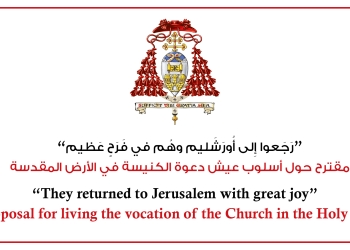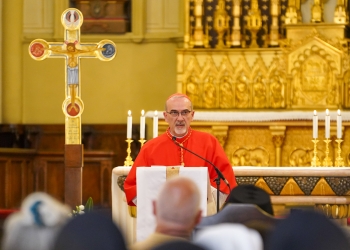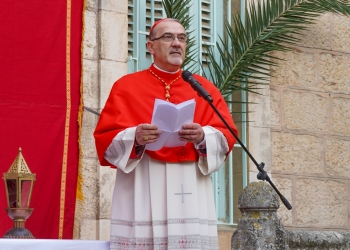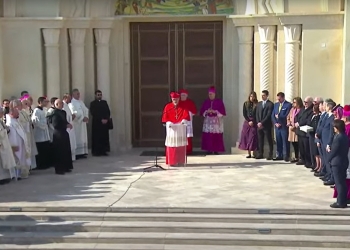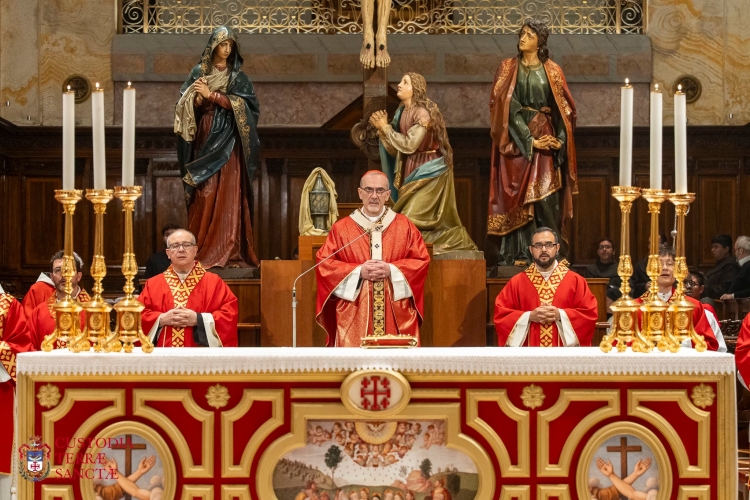
Conference Commissaries of the Holy Land 2025
Jerusalem, November 24, 2025
Dan 1:1-6,8-20; Lk 21:1-4
Dear brothers and sisters,
May the Lord give you peace!
I am deeply grateful and pleased to be here with you today to share the gratitude of the entire local Church for your valuable service to the Custody and to our whole ecclesial community, in which the Custody plays a special and fundamental role.
Meeting again in Jerusalem always has a unique significance. Nowhere else do the words of Scripture resonate with such intensity: every biblical page, every evangelical gesture seems to find a natural echo here, as if the land itself holds the memory of God’s works. Today’s readings, in the context of your Convention, illuminate the mission you carry out as commissaries – a mission that is not merely administrative or devotional, but deeply ecclesial and spiritual.
Today, the Word presents us with two figures: Daniel and the widow from the Gospel. A male figure, young and strong in faithfulness, and a female figure, fragile and poor, yet very rich in faith. Two different and complementary ways of living our relationship with God. Two mirrors in which to reflect on our mission and yours.
Faithfulness that does not allow itself to be assimilated
The passage about Daniel takes us to a dark moment in Israel’s history: the deportation to Babylon, the loss of landmarks, and forced cultural assimilation. A people uprooted from their land. This resonates with us, especially as we think of the many Christians in this region who still experience fragility, pressure, and sometimes marginalization. If we look at what has been happening for too long in the Holy Land, we see that, in the end, nothing is truly new. The forms change, but the dynamics are similar to those described in the biblical texts.
Daniel and his companions are given new names, educated according to the dominant culture, and invited to eat at the “king’s table.” It is not just about food; it is a project of assimilation, a strategy to make them forget who they are.
Yet Daniel “decides in his heart” not to defile himself. This is the decisive point: faithfulness is born in the heart, not in outward battles. It is a silent act, not ostentatious, but radical. It is not about standing against the world, but about remaining oneself in every context. Daniel does not engage in polemics or isolate himself; he dialogues, proposes alternatives, and exercises wise discernment. It is precisely this dialoguing faithfulness that God blesses with extraordinary wisdom.
One aspect of the conflict concerns the relationship between the different identities, histories, and affiliations that make up the Holy Land, which is Jewish, Islamic, and Christian together. Without each of these presences, the Holy Land and Jerusalem would not be complete. In this context, the work of the Custody is fundamental. Thanks to its centuries-long presence, it preserves the memory of the Christian presence in the Holy Land and its culture, showing how it has deep roots in this Land and has contributed enormously to the growth of these societies. Now we must continue to do this as a Church, together, in the way indicated by Daniel. We, too, are in danger of closing ourselves in our towers, of fleeing from the complexity and difficulty of encounter in this wounded and torn land. But, like Daniel, we are called to remain ourselves, remain capable of dialogue, propose alternatives, open new paths, and be faithful to the history that has always distinguished us. In the past, we opened paths by founding schools and hospitals; today, we must do so by opening free hearts and minds, creating contexts of trust.
Many of you live a similar ministry: to be faithful custodians of the Holy Land while serving in distant countries, in secularized or pluralistic contexts, amid economic challenges and differing ecclesial expectations. Being commisaries means not allowing yourselves to be assimilated by the logic of the world, but bringing to the world the logic of the Gospel and of the Custody: that of memory, of incarnation, of concrete proximity to the Christian communities of this land.
Daniel does not defend a dead tradition; he guards a living identity. So do you: guard the Places, yes, but above all the meaning, the history, and the faith that these Places embody. In some way, you guard the ״heartland״ of Christianity.
The gift that God measures in secret
The Gospel presents a simple scene: a crowd throwing offerings into the Temple treasury – much noise, much visibility. Then, a seemingly insignificant figure appears: a poor widow with two very small coins. It is a gesture no one would have noticed.
But Jesus sees her. Jesus looks where others do not. He looks at the heart, not the amount. He sees the sacrifice, not the appearance.
The widow does not give what she has left over; she gives what costs her. She does not calculate; she acts in trust. Her gift is small, but total.
Here in Jerusalem, this Gospel carries special weight. The Custody of the Holy Land survives thanks to the offerings of the faithful from around the world. Most of these offerings do not come from major benefactors, but from ordinary people: families, the elderly, young people, parishes who have “two pennies” to offer, but give them with love. These offerings are not just financial support; they are a bond of fellowship, a caress, an act of love for the Land of Jesus.
The widow does not speak, justify, or explain. She acts. It is a pure gesture that becomes gospel. In a time when everything is visible, measurable, and quantified, the Gospel reminds us that God’s logic is different: God measures what is unseen, evaluates what is hidden, and looks at the quality of love.
As commissaries of the Holy Land, you have an important role in supporting the life of the Custody, serving as a bridge between the churches of the world and the Mother Church in Jerusalem. But being commissaries also means being guarantors of the trust of the poor. It means turning the hidden gifts of the world’s many “little widow” into concrete support. It means, like Jesus, having a gaze capable of recognizing the infinite value of the humble and the small. You are not only supporters of the Custody; wherever you carry out your ministry, you are called to bring comfort and consolation, to help people recognize and – even, why not?—encounter Christ incarnate. To bring the Holy Land to the world is to bring Christ. Your service is pure evangelization, in the fullest and most beautiful sense of the word.
Fidelity and gratuitousness: the two pillars of mission
Daniel teaches us that mission is built on inner faithfulness. The widow teaches us that mission grows with gratuitousness of heart.
Without faithfulness, mission becomes empty. Without gratuitousness, mission becomes rigid.
The Custody of the Holy Land – and your service with it – needs both: integrity and gift, discernment and generosity, firmness and gentleness.
Today more than ever, in a Holy Land wounded by violence, division, and uncertainty, your role is precious: you are places of communion, ambassadors – as the theme of your conference suggests – of the universal Church to the Church in Jerusalem. You bring support, but also closeness; resources, but also hope; organization, but also spirituality.
In this time marked by challenges and uncertainties, your presence here is a sign of hope for many Christians who look to Jerusalem as a source of light and unity. I invite you, therefore, to bring to the world not only the memory of the Holy Land, and to speak not only of the conflict and pain that overwhelm it, but also its message of peace, dialogue, and fraternity that you have certainly encountered in the many people who still bear witness to it here. Be witnesses of a Church that knows how to welcome, listen, and build opportunities for encounter, even where it seems impossible. Each of you, in your daily life, can be a concrete sign of reconciliation and gratuitous love.
I like to think, inspired by today’s readings, that in your ministry you are like Daniel in Babylon: called to discern, to stand firm, to be light in complex times. And you are like the widow in the Temple: called to give of yourselves, to offer generously, to make possible the gift of the little ones.
We ask the Lord to grant each of you a faithful heart, which does not allow itself to be assimilated but enlightens; a poor heart, which gives itself unreservedly; a wise heart, capable of reading the times and guarding what is essential.
Thus, your service will continue to sustain this land, unique in the world because it is sanctified by the steps of God made man.
May the Lord bless you, confirm you in your mission, and make fruitful every gesture of love toward the Holy Land and those who inhabit it.
Amen.